A few months ago, I sat down with a mentoring client who was preparing to launch a capital-intensive startup. I asked her the question I ask everyone launching a new venture: how are you going to attract your first customers? She answered without hesitating. “With advertising, of course.”
It was a confident answer. It’s also the answer I hear from many first-time founders. Her reply is worth thinking through because underneath “with advertising, of course” is a question few people actually answered: what bet are you making, and what are you making it with?
Hold that question. We’ll come back to it. But first, a football play.
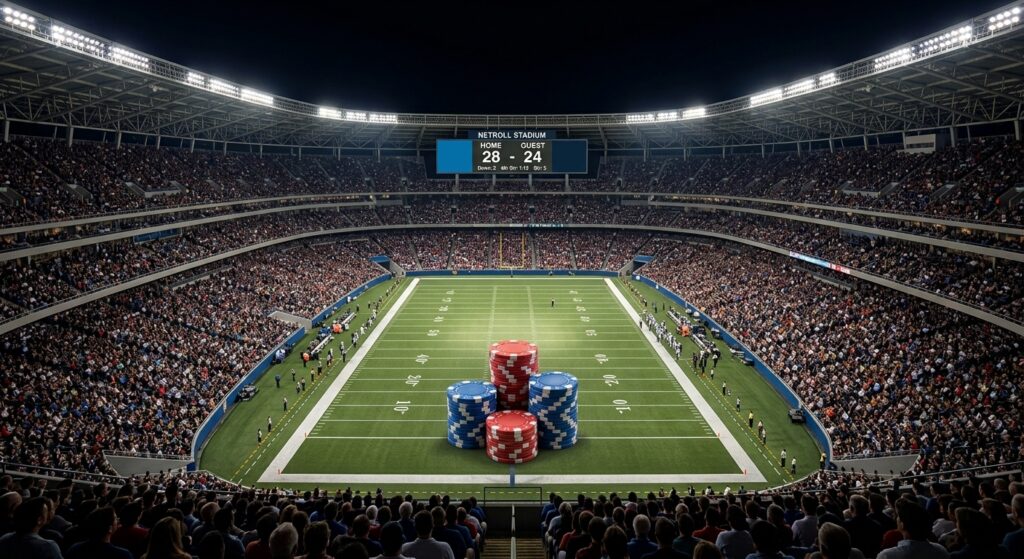
Super Bowl XLIX, February 2015. Seattle trailing New England 28-24 in the fourth quarter. 26 seconds left on the game clock. Seattle has the ball with one timeout left. It’s second down at the Patriots’ one-yard line. Marshawn Lynch, one of the best running backs in the league, had gained yardage all game. Everyone watching expected the handoff.
Instead, Seahawks head coach Pete Carroll called a pass. Russell Wilson threw a slant toward the goal line, Patriots rookie cornerback Malcolm Butler read it, jumped the route, and intercepted it. Game over. New England won.
Sports commentary has called it the worst play call in Super Bowl history ever since, and that verdict has never really been reconsidered, because the play failed. But here’s what the analytics actually showed: the pass-run-run sequence Carroll’s staff had lined up carried roughly a 97.9% chance of the Seahawks scoring, a 1.1% chance of being stopped short, and about a 1% chance of an interception. That’s close to a sure thing in football. And the 1% happened.
The Mistake Everyone Made Judging That Call
Poker player and decision scientist Annie Duke has a name for the mistake everyone made judging that call: “resulting.” It’s the habit of judging the quality of a decision by the quality of its outcome. Unfortunately, those are actually two different things. A good decision can lose. A bad decision can win. Driving home drunk without incident is the plainest version of the second one: the outcome was fine, the decision wasn’t, and if it happens enough times without a crash, you’ll start mistaking luck for skill, correlation for causation, “I got away with it” for “I know how to do this safely.” What actually happened is decision plus luck, and a single result rarely tells you how much of each was in the mix.
Carroll’s call wasn’t reckless. It was close to a mathematical lock. It just landed on the wrong side of that 1%. Which brings us back to my client and her answer.
“With advertising, of course” isn’t wrong because it might fail, or right because it might work. It’s incomplete, because it was never actually sized as a bet in the first place. She hadn’t asked what she actually knew about her market, what she was risking to find out, or what would happen to her business if the campaign failed. She reached for the obvious-sounding answer. That’s the real subject of this piece: advertising isn’t a channel decision, it’s a bet-sizing decision, and most small business owners never actually size the bet.
The Same Super Bowl, the Opposite Bet
If you want to see what it looks like when a business makes the opposite bet Carroll made, you don’t have to look far, it happened at the same event. In the 2000 Super Bowl, 11 dot-com startups spent a combined $44 million on 30-second ad spots. Computer.com put $3 million of its total $5.8 million in seed funding into a single ad, more than half the company’s entire funding round. Within a year, eight of those 11 companies were bankrupt or sold off in fire sales.
Notice the structure of that mistake. Carroll’s staff built a sequence specifically so that if the first move failed, they still had a second chance because an incomplete pass stops the clock without costing them their last timeout. The dot-com startups did the opposite. They put nearly all their capital into one unrepeatable, irreversible shot. If it didn’t succeed, there was little or no money left for a second play.
The Odds Were Already Against Them
And the odds a startup faces before it even makes that bet aren’t good to begin with. Bureau of Labor Statistics data puts first-year failure for new businesses at around 20%, climbing to roughly 49% within five years. For a scalable, funded startup like Computer.com, the number is much worse: about 90% are gone within five years. A startup’s ad bet isn’t happening in a vacuum. It’s stacked on top of odds that are already unfavorable before the campaign ever runs.
What You’re Betting With
There’s one more variable that matters as much as the odds: what you’re betting with. An established business that funds an ad campaign from operating income and sees no traction can absorb a bad month or two. It stings, but the business keeps running. In contrast, a startup that borrows money or gives up equity to fund the same campaign and gets the same result is left holding debt or a diluted ownership stake, with no revenue to offset it. Same bad outcome, completely different consequence, because the capital source determines what losing actually costs.
This is the same instinct behind my Ship of Gold post: the less risk you’ve wrung out of an idea before you go looking for outside money, the more it costs you, whether that’s a bigger ownership stake handed to an equity investor or worse terms and collateral demands from a lender. Early-stage work like market research, design, or even presales can often be bootstrapped without outside capital at all, debt or equity, so you’re not paying that premium for capital you didn’t actually need yet.
Why Smart People Still Say It Anyway
So why does a capable person still answer “with advertising, of course” without pricing any of that in first? To explain this, let’s revisit my client for a second. Her confidence that ads would produce her first customers wasn’t a character flaw. It’s a well-documented pattern known as the Dunning-Kruger effect: low competence in a specific skill, in this case customer acquisition, paired with high, unearned confidence that you already understand it. Psychologist David Dunning put it this way: “The incompetent are often blessed with an inappropriate confidence, buoyed by something that feels to them like knowledge.” People sitting at that peak of confidence, sometimes called “Mount Stupid,” aren’t lying or being reckless. They genuinely don’t yet know what they don’t know.
It compounds with something else: people too often reach for whatever worked in a different market or a different channel era, without understanding the mechanism that made it work in the first place. Advertising advice built for the TV and radio era, or for the early organic-search era, gets repeated today as if the underlying conditions haven’t changed. They have. AI search tools increasingly summarize organic reach, and the paid inventory that’s left is scarcer and pricier than it used to be, making an unsized bet even more dangerous today than it would have been a few years ago.
What a Sized Bet Looks Like
None of this means don’t advertise. It means take Carroll’s approach instead of Computer.com’s. Carroll’s staff didn’t avoid risk, they sized it and preserved a second chance in case the first move failed.
There’s a name for the instinct behind sizing a bet you can afford to lose rather than swinging for the fence in one go: the Affordable Loss Principle. It has a second half worth bringing in here too: the Leverage Contingency Principle. Many entrepreneurs use causal reasoning to plan extensively upfront, trying to predict every possible variable, often an impossible task, to hit the target on the first try. Carried too far, that either stalls into analysis paralysis, planning endlessly and never actually launching, or it commits everything to the one plan that got built, leaving little or nothing in reserve to adjust once real results come in.
Many successful entrepreneurs use effectual reasoning instead: plan for what’s expected, but hold resources back specifically so a surprise won’t sink the entire enterprise. Computer.com’s mistake wasn’t overplanning. It was building a plan with no contingency, so when the market’s actual response came back, there was nothing left to adjust with.
Say you have $10,000 to test a new business idea. The affordable loss principle doesn’t say bet all $10,000 on your best guess and see what happens. It says bet $2,000 on a small, reversible test, a minimum viable product, a soft micro-launch, a single test campaign, and measure what actually happens. If it doesn’t work, you still have $8,000 and something you didn’t know before, so you pivot and try another bet with another $2,000. If that doesn’t work either, you still have $6,000 left for a few more bets you can make before you’re out.
That’s not a metaphor borrowed from poker, it’s the same structure. Annie Duke spent years at the poker table before she became a decision scientist, and the logic is identical: you don’t shove all your chips in on the first hand and hope the cards cooperate, you bet a size you can afford to lose, see what the table tells you, and decide whether the next bet is worth making. Carroll’s thinking did the same thing with downs instead of chips. Run a play, see what the clock and the defense give up, and if unsuccessful, you still have a play or two left. Computer.com did the complete opposite. They took over half of their stack of risk capital and pushed it in on one hand, before they even knew if anyone wanted to play.
That’s the ad-budget version of Carroll’s sequence: size the first bet at what you can afford to lose, keep a second and third play available, and let real traction, not overconfidence, justify the next larger bet. In practice, that might mean testing with a referral program before a paid ad campaign, building an email list you own before renting an audience from a platform, such as Meta or Google, or running a small pay-per-lead test before committing to one large placement. The point isn’t which specific channel, it’s preserving the option to try again.
Pete Carroll never disowned that call. He’s said publicly, years later, that he still believes it was the right decision, even though it cost his team a championship. That’s the discipline underneath everything in this piece: judge the decision by what was known and what was being risked at the time, not by the story told once everyone already knows how it ended.
My client’s answer wasn’t wrong because advertising doesn’t work. It was incomplete because “with advertising, of course” was never actually sized as a bet. The businesses that survive long enough to scale aren’t the ones that never lose a bet. They’re the ones whose losses don’t end the business.
What’s the smallest version of this ad bet you could place, and would what’s left still be enough to pivot if it didn’t work?