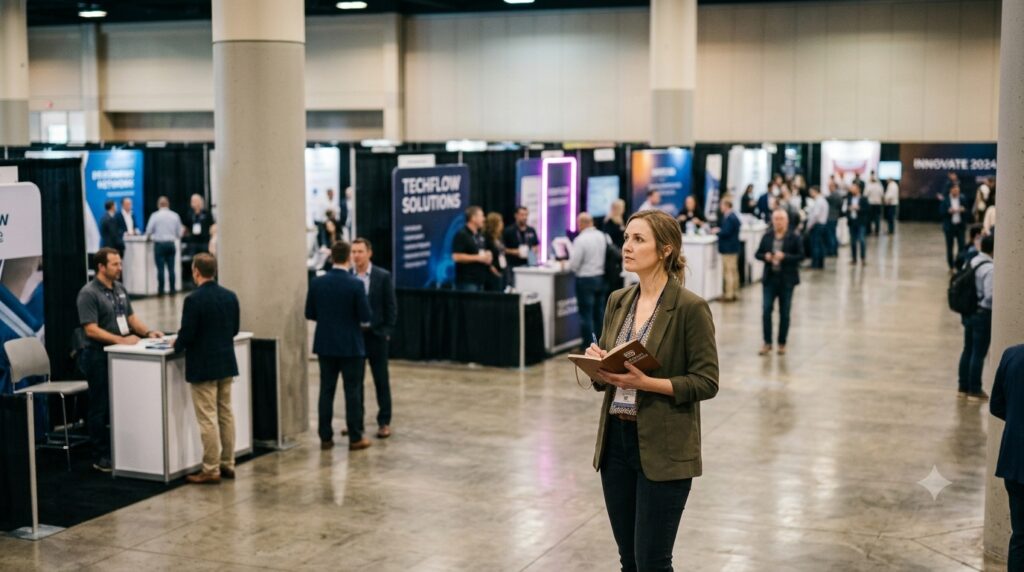
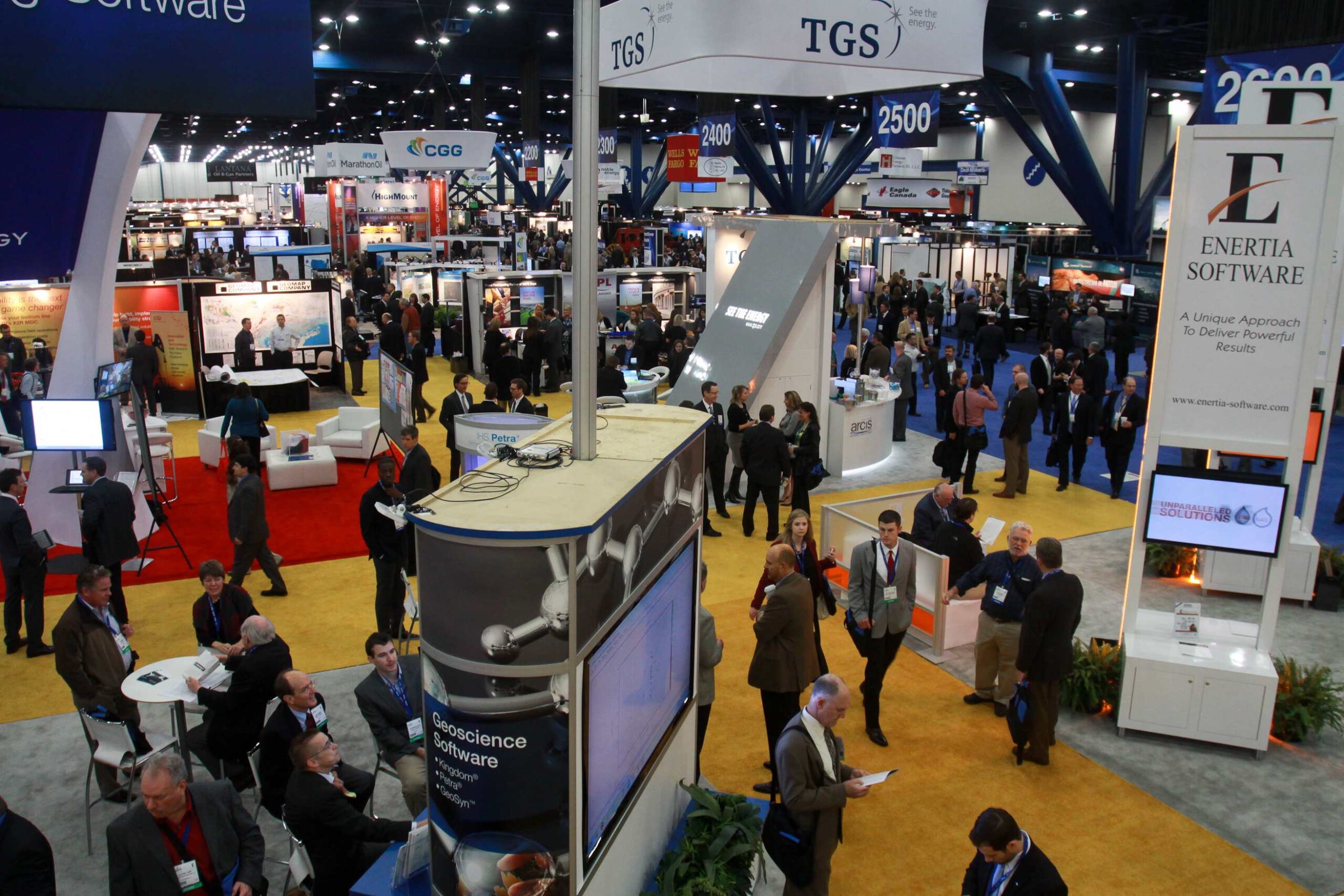
I’ve worked events on multiple continents at this point. Trade shows, government outreach sessions, local markets, chamber mixers, industry expos. Enough of them that I stopped noticing the booths and started noticing the people. What works, what doesn’t, who’s actually paying attention and who’s just putting in hours until the thing ends.
A while back I came across the writing of John Nolan, a former federal intelligence officer who spent 22 years in covert operations before building a corporate intelligence consultancy. Reading him was one of those moments where someone hands you the framework for something you’d already been doing instinctively.
Nolan’s argument is that trade shows and business events are unparalleled opportunities for intelligence, and almost nobody walking through the doors realizes they’re standing in the middle of one. That reframed my 20-plus years of event experience. I hadn’t been going to network. I’d been running low-grade intelligence operations without a name for it.
Most small business owners go to events to be seen. They polish their elevator pitch, stack their business cards, and work the room hoping to land a lead or two. That’s not wrong. But it’s only half the game, and most people never play the other half.
The other half is intelligence. Information you can walk away with that changes how you compete, price, position, or pursue a contract. John Nolan wrote the definitive book on this subject called Confidential: Business Secrets – Getting Theirs, Keeping Yours. Here’s what that looks like across three common small business scenarios.
Scenario One: The Government Meet-and-Greet
Government agencies, federal, state, and local, regularly host or attend small business networking events, procurement expos, and vendor outreach sessions. These are goldmines if you know what you’re doing.
Most small business owners show up hoping to impress. They pitch. They hand out flyers. They try to get a business card from the contracting officer and call it a win.
The smarter play is to listen and elicit.
Nolan makes a sharp distinction between interviewing and eliciting. Interviewing is when both parties know what’s being exchanged. Eliciting is a conversational approach in which direct questions are avoided, and information flows naturally, often without the other person realizing what they’ve shared. At a government event, the people in the room are there to engage. Agency staff often want small businesses to succeed in the bidding process. They’ll tell you things if you ask the right way, or more accurately, if you don’t ask at all.
What agencies show up matters. If an agency is actively attending small business outreach events, they have a procurement need or an upcoming contract cycle. That’s a signal.
Who they bring matters. A contracting officer attending alone is different from one attending with a program manager. The program manager owns the problem you’d be solving.
What they complain about matters. Agency staff members talk. They’ll mention frustrations with current vendors, timelines that slipped, deliverables that didn’t land, or programs that are being restructured. Each complaint is a map to an unmet need.
What they respond to matters. When you describe what your business does, watch the face, not the nod. Real interest looks different from polite acknowledgment. The question that makes them lean in is the one worth writing down later.
One practical technique from Nolan’s playbook: deliberate misstatement. Say something slightly wrong about how a procurement process works or what an agency typically requires, and let them correct you. The correction tells you exactly where the gap is between what you assumed and what’s actually true. That’s intelligence you didn’t have before you walked in.
I saw this play out firsthand as chapter chair of our local SCORE chapter, part of the national nonprofit that provides free mentoring to small business owners. In my capacity as the chapter chair, I attended a lot of government meet-and-greets, but not just as an attendee. I was also a presenter, which meant I got to stand up and explain what SCORE offered. That put me in an unusual position. The audience at those events wasn’t neutral. Most of them were small business owners already in active marketing mode, actively chasing a government contract. That’s a signal by itself. People don’t chase contracts when things are going fine. Somewhere behind that pursuit was usually a cash-flow problem or a growth goal they couldn’t solve any other way.
We treated the room that way on purpose. We weren’t there to pitch SCORE as a nice-to-have. We were there because the audience had already told us, just by showing up, that they needed exactly what we provided. That’s the intelligence lesson in miniature: the room tells you what it needs before anyone says a word, if you’re paying attention to why people are there instead of just what they say when you ask.
After the event, document what you heard before you lose it. Who said what, what problems came up, which agency reps seemed engaged.
Scenario Two: The Farmers Market or Community Fair
This one gets overlooked because the intelligence opportunity doesn’t feel obvious. But if you’re a vendor at a farmers’ market, a craft fair, or a community expo, you’re surrounded by useful data, and so is every competitor at the booth next to you.
What your neighbors’ booths are telling you:
Watch foot traffic. Which booths draw a crowd and which don’t? The difference is rarely the product. It’s almost always the presentation, the price point, the positioning, or the first line out of the vendor’s mouth. You can study all of that for free just by paying attention.
Listen to what customers ask other vendors. When someone walks up to a booth near you and asks a question, that question is market research you didn’t have to pay for. “Do you have anything gluten-free?” “Is this locally sourced?” “Do you take credit cards?” Each question signals what the market wants and where the gaps are.
Notice what people pick up and put back down. Body language at a fair is honest. The item someone examines and then sets back is telling you something. So is the item they ask the price on and then walk away from. That’s pricing intelligence in real time.
What your own booth is revealing:
This is the counterintelligence piece Nolan emphasizes. Your booth staff, meaning you, a partner, or anyone working alongside you, are being observed the same way. Competitors walk fairs. They listen. They ask questions framed as casual customer interest. “How long have you been doing this?” “Where do you source your materials?” “Do you do custom orders?”
These aren’t idle questions. Think before you answer. Enthusiasm is the enemy of discretion. The vendor, who is excited to talk about their process, supplier relationships, and upcoming products, is sharing that information with everyone within earshot.
I got a sharp lesson in this at Pike Place Market in Seattle, one of the oldest and most persistent public markets in the country. Walking through it, what struck me wasn’t the produce or the crafts. It was how many people staffing the booths were on their phones, not engaging anyone walking by. It had the feel of hired help clocking hours rather than owners with skin in the game. No eye contact, no opening line, nothing. Foot traffic walked right past them.
That’s counterintelligence failure in plain sight. Whether you’re gathering information or just trying to sell tomatoes, the booth that isn’t paying attention is broadcasting something too: that nobody there cares enough to notice you. Customers read that instantly, even if they couldn’t articulate why they kept walking.
The relationship map:
Fairs and markets also reveal who knows who. Watch which vendors stop to talk to each other. Watch which vendors the organizers spend time with. Relationship mapping, understanding who has influence and who doesn’t, is part of how Nolan teaches people to understand an environment. In a small vendor community, that map shows where informal power lies and who the connectors are. Those are the people worth knowing.
Scenario Three: The Business Services Expo
These events, where insurance brokers, banks, marketing agencies, accountants, chambers of commerce, and service providers set up booths to attract small business clients, look like they’re all about selling to you. And they are. But flip the frame, and they become something more useful.
Every vendor booth is a research source:
The people staffing booths at a business services expo are subject matter experts who want to talk. They’ve been trained to engage, they know their industry deeply, and they’re highly motivated to share what they know. That makes them ideal sources.
An insurance broker at an expo can tell you what coverage small businesses in your industry are underinsured on, which tells you what risks your competitors are probably ignoring. A banker can tell you what loan products are most popular with businesses your size, which tells you how your competitors are financing growth. A marketing agency rep can tell you which platforms are delivering the best results for their small-business clients right now.
None of this requires deception. You’re just asking better questions than everyone else. Most booth visitors ask “what do you sell?” Nolan’s approach is different: get them talking about the market, the trends, the problems their clients bring to them. The service they’re selling is the door; the intelligence is what’s behind it.
At every expo I’ve worked, I made a deliberate choice: move the table to the back of the booth. That forces your people to stand in the aisle rather than hide behind furniture. A table is a barrier. It tells people not to approach. Standing in the aisle says the opposite.
We also spent roughly equal time in two ways: talking to visitors coming to the booth and talking to the other exhibitors around us. That second half is where a lot of the real intelligence showed up. Fellow exhibitors will tell you things attendees won’t, about which sponsors are cutting back, which vendors are struggling to fill their calendar, which topics are drawing crowds elsewhere in the hall. Most people work an expo booth in one direction only. Working it in both doubles what you walk away with.
If the expo has any educational sessions or panels, attend them with a notebook and a different agenda than the other attendees. Most people are there to learn the presented content. You’re also there to read who’s in the room, what questions the audience asks, what problems the presenter cites as most common, and what topics generate the most reaction. That’s a live survey of what’s keeping your peers up at night.
The registration list as intelligence:
Many expos publish an attendee or exhibitor list in advance. That list tells you who considers themselves part of your market. It tells you which competitors are investing in visibility and which aren’t. It tells you which agencies or organizations are engaged with the small business community. Research the list before you arrive.
The Mindset Shift That Makes This Work
Nolan’s core argument isn’t about tricks. It’s about frame. Most people at any event are in broadcast mode. They’re thinking about what they’re going to say next. The small business owner operating in intelligence mode is in receive mode, listening, observing, and connecting dots.
That means going to events with specific questions you want answered, not just a stack of cards and a pitch. It means staying in conversations a little longer than feels comfortable, because the useful information usually comes after the surface exchange. It means writing things down afterward, before the details blur.
And it means knowing when to stop talking. Nolan quotes a simple rule: God gave us two ears and one mouth, and we should use them in that proportion. At your next event, whatever kind it is, try flipping the ratio. You might be surprised what you come home with.
How much business intelligence did you walk out of your last event with, and how much did you leave on the table?