Earlier this year, I published a post entitled “The Evolution of AI Use: From Tools to Agents and What Comes Next.” At the time, I described AI as progressing through a fairly logical sequence. We began with search, moved into conversational AI, and were starting to see the emergence of intelligent agents capable of performing increasingly sophisticated work.
Over the past several months, however, both the technology and my own thinking have evolved. I no longer believe that AI is best understood as a linear timeline in which each new capability replaces the one before it. Instead, I’ve come to see it as an architecture, one in which multiple capabilities mature simultaneously, each solving a different problem while reinforcing the others.
Interestingly, that realization didn’t come from studying commercial AI.
Like many people, I found myself following news about modern military conflicts and how today’s militaries make decisions on an increasingly complex battlefield. As I tried to understand it, I repeatedly encountered discussions about Palantir as a battlefield decision platform. The more I read, the more I realized these systems weren’t simply “using AI.” They were integrating information from satellites, drones, sensors, intelligence reports, aircraft, ships, and troops on the ground into a single operating picture. AI wasn’t replacing human decision-makers. It was helping them understand relationships, recognize patterns, coordinate resources, evaluate alternatives, and respond faster than any individual could manage alone.
What struck me wasn’t the technology itself. It was the architecture behind it.
Modern battlefields have become interconnected systems. Every sensor, every data source, every communication channel, and every decision contributes to a larger network that continually improves situational awareness and operational effectiveness. The power doesn’t come from any single piece of technology. It comes from how those technologies work together.
As I thought about it, I realized businesses are evolving in exactly the same direction.
Customers, employees, suppliers, inventory, accounting systems, marketing platforms, manufacturing equipment, and countless business processes all generate information. The challenge is no longer collecting data. Most organizations already have more information than they know what to do with. The challenge is organizing that information into a system that improves decisions, coordinates activity, and eventually allows appropriate work to be delegated safely to AI.
Then another connection occurred to me. I could apply the same architectural approach to build my own Intellectual Operating System to improve SteveBizBlog. The same architectural principles that make modern battlefield decision systems effective also apply to building an AI capable of understanding and supporting a business.
That realization changed how I now think about AI evolution.
We’ve spent the past few years describing AI as though it advances through a series of generations. First, there was search. Then conversational AI. Next came augmented retrieval systems, and now everyone is talking about intelligent agents.
I don’t think that’s what is actually happening. AI isn’t evolving through a straight line. It’s evolving through an architecture.
AI Is Evolving Along Four Independent Dimensions
Most discussions about artificial intelligence describe it as though one technology replaces another. Search gave way to Chat. Chat gave way to retrieval systems. Retrieval systems are now giving way to intelligent agents. While that narrative is easy to understand, it doesn’t accurately describe what has actually happened.
Search didn’t disappear when conversational AI arrived. In fact, modern AI still relies heavily on search. Likewise, conversational AI didn’t become obsolete when persistent workspaces were introduced. Businesses continue using chat every day because conversation remains the most natural interface for collaborating with AI. The same pattern continues with Retrieval-Augmented Generation, ontologies, Knowledge Graphs, APIs, workflow automation, and intelligent agents. None of these technologies replaces the others. Each addresses a different limitation while preserving and extending existing capabilities.
I think a much more useful way to understand today’s AI landscape is to stop thinking about generations of technology and start thinking about dimensions of capability.
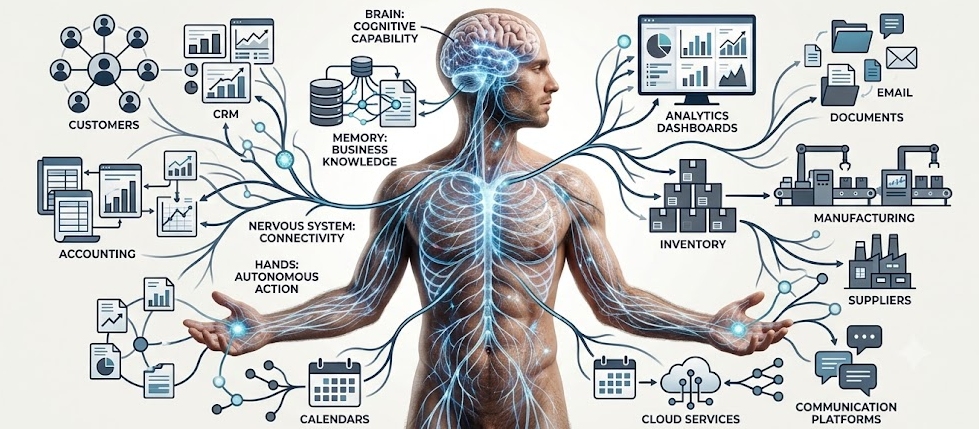
Imagine the human nervous system for a moment. Your brain processes information, your memory preserves experience, your nervous system carries signals throughout the body, and your muscles perform physical work. None of those systems is more important than the others. They all work together. Remove any one of them, and the entire system becomes dramatically less capable.
Modern AI is beginning to evolve in much the same way. Rather than progressing along a single timeline, it is simultaneously becoming better at thinking, understanding businesses, interacting with other systems, and safely performing work. These four dimensions reinforce one another, gradually transforming AI from a useful tool into an intelligent operating system for the business.
Dimension
What Is Evolving?
The Fundamental Question
Cognitive Capability
How AI thinks and reasons
Can it reason better?
Business Representation
How AI understands the business
Does it truly understand my business?
Connectivity
How AI interacts with systems and data
Can it work with the rest of my organization?
Autonomy
How much responsibility can AI safely assume
Can I trust it to act on my behalf?
AI depends upon the convergence of all four dimensions. Understanding that convergence, rather than focusing on the latest AI feature or product announcement, provides a much more accurate way to think about where artificial intelligence is really headed. That said, let’s examine each of these dimensions independently.
Cognitive Capability
Question:How does AI become better at thinking?
When people talk about advances in artificial intelligence, they’re usually referring to improvements in reasoning. AI seems to understand more, solve more complex problems, and produce better answers than it did just a few years ago. While that’s certainly true, those improvements didn’t happen all at once. Each generation solved a different limitation while preserving the capabilities that already existed. Looking at that progression helps explain why today’s AI feels fundamentally different from the search engines and chatbots many of us were experimenting with only a short time ago.
Search
The first breakthrough was Search. For decades, search engines have transformed the way we find information by organizing the ever-growing internet into something we can explore within seconds. Before Google, locating information often meant manually browsing websites. Search solved that problem extraordinarily well. It helped us find the right information. What it didn’t do was help us understand it. Search engines returned links, not conclusions. They couldn’t compare competing viewpoints, identify patterns across multiple sources, or explain why one answer might be more appropriate than another. The reasoning still belonged entirely to the person sitting behind the keyboard.
That distinction is important because, for many years, information itself was the scarce resource. Businesses competed by gaining access to knowledge that was difficult to locate. Today, the opposite is true. Information is abundant. Almost every business owner has access to more articles, videos, reports, podcasts, and opinions than they could possibly consume. The competitive challenge has shifted from finding information to making sense of it. That change created the opportunity for the next major capability.
AI-Enhanced Search
AI-enhanced search didn’t replace traditional search. It simply removed another layer of work from the human. Instead of returning a list of websites, AI began reading those sources, identifying common themes, summarizing key ideas, and presenting a coherent answer before you ever clicked a link. Equally important, search became conversational. If the initial response wasn’t quite what you needed, you could ask follow-up questions, request clarification, compare alternatives, or ask for an explanation tailored to your particular situation. Rather than beginning every search from scratch, you began refining your understanding through dialogue.
From a business perspective, that may seem like a small improvement, but it represents an important shift. Search stopped being merely a retrieval tool and began participating in the reasoning process. Humans still directed the conversation, but AI increasingly helped interpret the information it had found rather than simply locating it.
Chat Continues to Evolve
Conversational AI represented another significant step, but not because it made search obsolete. It changed the relationship between people and information. Instead of asking a series of disconnected questions, we began collaborating with AI in much the same way we might work with an experienced colleague. Conversations became iterative. We could brainstorm ideas, test assumptions, critique plans, explore alternatives, and gradually improve our thinking through dialogue.
That capability continues to expand today. Modern chat systems can now analyze images, review spreadsheets, summarize lengthy reports, write software, conduct deep research, reason through complex business problems, generate presentations, and interact with external tools. Context windows continue to grow, allowing AI to maintain far richer conversations than were possible only a year or two ago.
At the same time, deployment options have expanded beyond the browser. Applications like ChatGPT’s Desktop Work and Claude’s Desktop Cowork, allow businesses to run increasingly capable AI systems that interact directly with local files, applications, and private business information while giving organizations greater control over security and governance.
The important observation is that chat itself never stopped evolving. It wasn’t a destination. It became another foundational capability that continues to improve while supporting everything built on top of it.
The Evolution of Memory
One of the least appreciated developments in AI has been the steady evolution of memory. Early conversational systems remembered almost nothing. Every new session began with a blank slate, forcing users to continually repeat information and rebuild context. That limitation made AI useful for answering isolated questions but far less effective as a long-term collaborator.
Gradually, memory began to expand. Conversations could retain context during a single session. Platforms introduced custom instructions and user profiles so AI could remember basic preferences across multiple conversations. More recently, projects and notebooks created dedicated working environments where conversations, documents, and files share a common context while remaining separate from unrelated work. A legal research project no longer interferes with a marketing strategy, and a software development effort doesn’t become mixed with family vacation planning.
The significance of this evolution extends well beyond convenience. Memory is gradually shifting from remembering conversations to preserving organizational context. Instead of repeatedly explaining your business, AI increasingly begins with an understanding of the environment in which your business operates. That progression naturally leads to the next question. If AI is going to reason effectively within a business, what exactly must it understand?
Business Representation
Question:What must AI understand about my business?
If cognitive capability is about improving AI’s ability to think, business representation is about improving what AI has available to think about. Those are two very different challenges. We often assume that a more intelligent AI will naturally produce better business decisions, but intelligence alone isn’t enough. Imagine hiring the smartest consultant in the world and asking them to help run your company. If they knew nothing about your products, customers, operating procedures, pricing model, employees, or history, you wouldn’t expect particularly useful advice. Before they could offer meaningful recommendations, they’d need to spend considerable time learning how your business actually works.
Artificial intelligence faces exactly the same challenge. General-purpose AI has extraordinary reasoning ability, but without business context, its recommendations remain generic. The next stage in AI’s evolution, therefore, isn’t simply making AI smarter. It’s giving AI an increasingly accurate representation of the business itself. That representation develops through several complementary architectural layers. Each solves a different problem, and together they create the business context that allows AI to move beyond answering general questions toward reasoning within the unique environment of your organization.
Persistent Workspaces
Most conversations with AI begin and end within a single chat. Once the discussion is over, the context gradually disappears, and the next conversation often starts from scratch. While modern AI systems have introduced limited memory that can remember general preferences and information about you across conversations, its memory is still rather limited, so most work remains isolated within individual chats.
Persistent workspaces fundamentally change that model by creating dedicated environments where conversations, documents, and supporting materials remain together around an ongoing body of work. Today’s platforms implement this idea in different ways. OpenAI and Claude use Projects, Google’s Gemini and NotebookLM organize work into Notebooks, and other platforms provide similar collaborative workspaces. Regardless of the name, the underlying concept is the same. Instead of repeatedly explaining the context of a project by uploading the same documents or recreating the same background information, you establish a persistent working environment that both you and the AI continue developing over time.
For example, “Steve Imke’s Intellectual Operating System,” which I recently developed, exists as a persistent project. Rather than starting every writing project from scratch, I maintain governance documents, operating manuals, editorial standards, and supporting reference materials in that workspace. Every new conversation in the SI-IOS begins with that accumulated context already available. The AI doesn’t have to rediscover how the system works because the governing documents remain part of the project’s working environment.
Over time, those workspaces naturally become much more than a collection of conversations. They become the organization’s repository of accumulated knowledge. Policies, operating procedures, product documentation, strategic plans, customer information, pricing models, historical decisions, meeting notes, research, and countless other business assets begin to live together in a single organized environment. Unlike the public Internet, this repository is unique to your organization. It represents years of experience, judgment, and institutional knowledge that competitors cannot simply download.
That distinction becomes important because the workspace itself isn’t the intelligence. It is the environment that preserves the organization’s institutional knowledge. Once that knowledge exists in a structured repository, AI can begin retrieving the specific information it needs before formulating a response. That retrieval process is the next architectural layer.
Retrieval-Augmented Generation (RAG)
Once an organization has established a repository of business knowledge, the next question becomes how AI should use it. This is where Retrieval-Augmented Generation, more commonly known as RAG, fundamentally changes the way AI reasons.
One of the biggest misconceptions about artificial intelligence is that it immediately begins generating an answer as soon as you ask a question. A properly designed RAG system follows a much more disciplined process.
Before formulating its response, the AI searches the organization’s repository for information relevant to the question. If you ask about employee vacation policies, it retrieves the actual time-off policy document. If you ask about a particular product, it retrieves engineering specifications, pricing information, and product documentation. If the discussion involves a customer, it retrieves the customer’s history, previous interactions, and any other relevant business information. Only after reviewing the organization’s own knowledge does the AI begin reasoning about the question and constructing its response.
That distinction is significant because it changes where the AI derives its confidence. Instead of relying primarily on what it learned during training, it grounds its reasoning in your business’s own accumulated knowledge. In effect, the repository becomes the organization’s source of truth, and RAG ensures the AI consults that source before it begins thinking. RAG doesn’t necessarily make AI more intelligent. It makes AI better informed by ensuring that its reasoning begins with the information your organization considers authoritative.
Ontology
RAG ensures that AI begins its reasoning by consulting the organization’s own repository. That is a significant improvement over relying solely on the model’s training, but it introduces another challenge. Retrieving documents is not the same as understanding the business they describe. Before AI can reason effectively, it must understand what those documents actually represent within the organization.
This is where an ontology becomes essential. Rather than simply retrieving information, an ontology gives AI a structured understanding of the business itself. At first glance, that may sound like a subtle distinction, but it represents one of the most important architectural advances in business AI.
Consider how most organizations store information today. Customer information might live in a CRM system, invoices in accounting software, employee records in a human resources application, product specifications in engineering documents, and contracts in a document management system. Although those systems all contain valuable information, they often describe the same business using different terminology, different formats, and different assumptions. Humans naturally bridge those differences because we already understand what a customer, employee, supplier, invoice, or purchase order represents. Artificial intelligence needs that same understanding before it can reason effectively across the organization.
An ontology provides that shared understanding. Rather than simply identifying ABC Manufacturing as one of your customers, the ontology first defines what a customer is. Every customer shares a common structure consisting of attributes such as a legal business name, customer number, billing and shipping addresses, assigned account manager, payment terms, credit limit, active contracts, purchase history, service history, and countless other characteristics that describe the relationship. The same approach applies to suppliers, employees, products, invoices, projects, facilities, equipment, and every other significant business object.
More importantly, the ontology establishes a common language across the organization. When AI encounters the word “customer,” every system now interprets it the same way. When it analyzes a purchase order, an invoice, or a service agreement, it understands the role each plays within the business rather than treating them as unrelated pieces of text. In many respects, an ontology becomes the organization’s business vocabulary. It defines not only what things are called, but what they mean.
Knowledge Graphs
Once the business objects have been defined, the next logical step is connecting them. This is the role of a Knowledge Graph. If the ontology provides the nouns of the business, the Knowledge Graph provides the verbs and relationships that turn those nouns into a coherent story. One way to think about it is in terms of grammar. The ontology identifies the people, places, and things that exist within the business. The Knowledge Graph defines how those things are purchased, supplied, manufactured, reported to, depend upon, shipped to, maintained, and interact with one another. Individually, the nouns describe what exists. Together, the relationships describe how the business actually works.
Imagine a customer places an order for one of your products. That single event immediately touches dozens of other parts of the business. The customer purchased a specific product. That product may be assembled from components supplied by multiple vendors. Those components arrive through your supply chain, are manufactured on specific equipment, inspected by designated employees, shipped via designated carriers, covered by a warranty, supported by a service team, and ultimately reflected in your financial statements. None of those relationships exists in isolation. Every business decision creates consequences that ripple throughout the organization.
A Knowledge Graph makes those relationships explicit. Instead of storing disconnected facts in separate applications, it connects customers to products, products to suppliers, suppliers to purchase orders, purchase orders to inventory, inventory to manufacturing, manufacturing to equipment, equipment to maintenance schedules, maintenance schedules to technicians, and every other meaningful relationship that exists within the business. AI no longer sees isolated documents or database records. It begins seeing an interconnected business ecosystem.
That ability fundamentally changes the kinds of questions AI can answer. Instead of asking, “What is this customer’s purchase history?” AI can begin asking, “If this supplier experiences a two-week delay, which customers will be affected, which products will become unavailable, which purchase orders must be rescheduled, and what impact will that have on revenue?” Those are business reasoning problems rather than information retrieval problems, and they are only possible because the relationships themselves are represented.
Taken together, Persistent Workspaces, organizational repositories, Retrieval-Augmented Generation, ontologies, and Knowledge Graphs should not be viewed as competing technologies. Each solves a different problem.
Persistent Workspaces provide the environment.
The organizational repository preserves institutional knowledge.
RAG retrieves the relevant information.
Ontologies define the business vocabulary.
Knowledge Graphs reveal how everything connects.
Individually, each layer adds value. Together, they progressively transform AI from a system that simply answers questions into one that increasingly understands how the business actually operates.
That understanding, however, is still only part of the equation. An AI may understand your business remarkably well, but if it cannot interact with the systems that run the business, its recommendations remain little more than advice. The next dimension addresses exactly that challenge.
Connectivity
Question:How does AI work with the rest of the business?
If the previous section focused on helping AI understand the business, this section focuses on helping AI participate in the business. Those are very different capabilities. An AI may possess remarkable reasoning skills and have a deep understanding of your organization, but if it cannot interact with the systems that actually run the business, it remains little more than an exceptionally knowledgeable advisor. It can recommend what should happen without having any ability to help make it happen.
Imagine hiring an outstanding chief operating officer and then telling them they couldn’t access your accounting software, customer relationship management system, inventory records, email, calendar, project management platform, document repository, or production systems. They might still offer excellent advice, but they would spend most of their time asking someone else to perform even the simplest task. Their intelligence wouldn’t be the limitation. Their inability to interact with the business would.
Artificial intelligence runs into the identical problem.
APIs
The first major breakthrough came through Application Programming Interfaces, more commonly known as APIs. Although the term sounds technical, the concept is straightforward. An API provides a standardized way for one software application to communicate with another. Instead of AI operating in isolation, it could begin requesting information from business systems and, when appropriate, sending information back.
That seemingly simple capability dramatically expanded AI’s usefulness. Rather than asking someone to manually copy customer records into a conversation, AI could retrieve the information directly from the CRM. Instead of manually checking inventory before answering a customer’s question, AI could access real-time inventory levels. The AI was no longer limited to the information contained within its own conversation. It could begin interacting with the digital systems that already operated the business.
Workflow Automation
As AI gained access to multiple applications, another opportunity naturally emerged. Instead of interacting with one system at a time, AI could begin coordinating work across several systems simultaneously. This is the foundation of workflow automation.
Many businesses are already familiar with workflow automation platforms such as Make, Zapier, Microsoft Power Automate, or n8n. These platforms connect different applications and automatically execute a series of predefined steps when a specific event or trigger occurs. For example, receiving a new customer order might automatically create a CRM record, generate an invoice, update inventory, notify production, schedule shipment, and send a confirmation email. Traditional workflow automation excels at executing these well-defined sequences because every decision has already been anticipated and built into the workflow.
AI introduces a fundamentally different capability. Instead of simply following predefined rules, AI can increasingly assess the situation before deciding what to do next. It can recognize exceptions, identify missing information, detect unusual circumstances, recommend alternative courses of action, and adapt the workflow when conditions differ from the original expectations. Rather than asking, “What step comes next?” AI begins asking, “Given the situation, what is the most appropriate next step?”
That distinction may seem subtle, but it represents an important shift. Traditional workflow automation executes the process that humans designed. AI increasingly participates in designing the path through the process as it runs. The workflow becomes progressively more intelligent instead of merely more automated.
Standardized Connectivity
As organizations adopted dozens or even hundreds of business applications, another problem began to emerge. Every application exposed its own API, meaning every integration had to be designed, built, and maintained separately. Connecting AI to five business systems often meant creating five completely different integrations, each using its own rules, authentication methods, and programming interfaces. As software evolved, every one of those connections became another potential point of failure.
This challenge is driving the emergence of standardized communication protocols such as the Model Context Protocol (MCP) and similar architectural approaches. Rather than requiring AI developers to learn a different API for every application, these standards define a common language through which AI can communicate with many different business systems.
A useful analogy is USB. Before USB, every peripheral required its own connector. USB established one standard that allowed thousands of different devices to communicate with computers. MCP and similar protocols are attempting to do something similar for AI.
Business owners don’t need to understand the technical details to appreciate the business impact. Standardization reduces integration costs, simplifies maintenance, improves reliability, and allows AI to interact with an expanding ecosystem of software without requiring every connection to be built from scratch. As more applications adopt common standards, connecting AI to the rest of the business becomes dramatically simpler.
Enterprise Orchestration
Ultimately, the objective isn’t connecting AI to one application or even a handful of applications. The objective is orchestrating work across the entire organization. A modern business is already an interconnected system composed of financial software, customer management platforms, supply chain systems, communication tools, manufacturing equipment, marketing platforms, document repositories, analytics, and countless other specialized applications. Real business decisions rarely involve only one of them.
Enterprise orchestration recognizes that reality. Rather than treating each application as an independent island, AI begins coordinating activity across the entire organization. A single customer request may trigger interactions with accounting, inventory, production, shipping, customer service, and executive reporting, all while preserving the context necessary to make informed decisions along the way. The individual systems continue to perform their specialized functions, but AI is increasingly the layer that coordinates information, recommendations, and actions across all of them.
By this point, the business nervous system analogy becomes much easier to appreciate. Cognitive capability serves as the brain. Business representation provides memory and understanding. Connectivity is the network of nerves that carries information throughout the organization. Yet even with those three dimensions in place, one important question remains unanswered. How much responsibility should AI actually be trusted to assume? That question brings us to the final dimension of AI’s evolution.
Autonomy
Question:How much responsibility should AI be trusted to assume?
If cognitive capability determines how well AI can think, business representation determines what it understands, and connectivity determines what it can interact with, autonomy determines how much responsibility we are willing to delegate. This is perhaps the most misunderstood dimension of AI because people often confuse intelligence with trust. The two are related, but they are certainly not the same thing. Just because an AI can perform a task doesn’t mean it should do so without human involvement.
The progression has actually been quite gradual. Before artificial intelligence entered the workplace, people performed virtually every business activity themselves. We searched for information, analyzed reports, made decisions, completed transactions, and coordinated work across the organization.
Early AI systems served primarily as assistants. They answered questions, summarized documents, drafted emails, and helped people complete individual tasks more efficiently. Humans still remained responsible for every meaningful decision.
As confidence in AI has grown, that relationship has begun to change. Instead of simply providing information, AI increasingly evaluates alternatives, identifies potential problems, recommends actions, and explains the reasoning behind those recommendations. Many organizations are already comfortable allowing AI to draft customer communications, identify unusual financial transactions, prioritize sales opportunities, or recommend inventory purchases, while reserving final approval for a person. In these situations, AI has become an advisor rather than merely a tool.
The next step is allowing AI to perform well-defined work under carefully established business guardrails. If an invoice exactly matches an approved purchase order, AI may be authorized to process the payment automatically. If inventory falls below a predefined threshold, AI may generate a replenishment order. If a customer submits a routine service request, AI may classify the issue, gather the necessary information, and begin the resolution process before a human ever becomes involved. Notice that the responsibility being delegated is narrow, well understood, and carefully governed. Organizations build trust one business process at a time rather than attempting to automate everything at once.
This gradual progression illustrates an important principle. Autonomy is not an all-or-nothing decision. It is a continuum. As AI demonstrates consistent performance within clearly defined boundaries, organizations become increasingly comfortable expanding the scope of responsibility they delegate. Trust grows through repeated success, just as it does with employees. Few business owners would place a new employee in charge of the entire company department on their first day. Responsibility increases as competence and reliability are demonstrated over time.
That distinction becomes especially important because it leads directly to the concept of Agentic AI. Many people describe intelligent agents as simply the next generation of AI. I don’t think that’s an accurate description. Agentic AI isn’t merely the highest level of autonomy. It represents something much more significant. It becomes possible only when every dimension we’ve discussed throughout this post has matured sufficiently to support it.
Agentic AI Is Capability Convergence
At first glance, Agentic AI appears to be about autonomous action. In reality, it is about architectural convergence. An intelligent agent doesn’t exist simply because an AI model becomes smarter. It emerges when cognitive capability, business representation, connectivity, and operational autonomy have matured sufficiently to work together as one integrated system.
An agent typically begins with a trigger. That trigger may come from a person submitting a request, another application generating an event, a sensor reporting changing conditions, a scheduled activity reaching a deadline, or even another AI agent requesting assistance. Unlike a chatbot waiting patiently for someone to ask a question, an agent continuously responds to events occurring throughout the business.
Once triggered, the agent begins reasoning. It retrieves relevant knowledge from the organization’s repository, understands the business objects involved through the ontology, follows relationships represented within the Knowledge Graph, gathers current information from connected business systems, evaluates possible courses of action, applies the organization’s business rules and operational guardrails, performs approved work, monitors the results, and determines whether additional action is necessary. What appears to be a single intelligent action is actually the coordinated operation of every architectural layer we’ve discussed throughout this article.
Remove any one of those layers, and the system immediately becomes less capable. Without reasoning, the agent cannot evaluate alternatives. Without business knowledge, it lacks organizational context. Without ontologies and Knowledge Graphs, it fails to understand how decisions affect other parts of the business. Without connectivity, it cannot interact with operational systems. Without carefully designed guardrails, it cannot be trusted with meaningful responsibility. Agentic AI is therefore not merely another feature of artificial intelligence. It is the natural convergence of increasingly capable reasoning, increasingly complete business understanding, increasingly rich connectivity, and increasingly trusted operational autonomy.
Looking back, it’s interesting that the same architectural pattern appears everywhere. Modern battlefields, intelligent businesses, and even my own Intellectual Operating System all rely on the same underlying principle. Intelligence doesn’t emerge from a single extraordinary capability. It emerges from many complementary capabilities working together as one coherent system.
The Real Competitive Advantage
If you’ve followed the evolution of AI over the past few years, it’s easy to become distracted by the constant stream of new announcements. Every few weeks, another model appears. Another capability is introduced. Another company claims to have built the next breakthrough. Those developments are certainly interesting, but I think they sometimes cause us to focus on the wrong question. Instead of asking what AI can do next, business owners should probably be asking what kind of business they’re building for AI to support.
Throughout this post, we’ve looked at four independent dimensions of AI evolution. Cognitive capability continues improving how AI reasons. Business representation improves how well AI understands the organization itself. Connectivity allows AI to participate in the day-to-day operation of the business. Autonomy gradually expands the responsibility businesses are willing to delegate. Individually, each dimension adds value. Together, they create something far more significant than any one technology could deliver on its own.
I suspect many organizations will continue to spend the next several months or years concentrating almost exclusively on acquiring better AI models. That’s understandable because new models receive most of the headlines. History suggests, however, that competitive advantage rarely comes from buying the same technology everyone else can purchase. If every competitor has access to increasingly capable AI, then the AI itself eventually becomes part of the cost of doing business rather than a meaningful differentiator.
The more enduring advantage will likely come from everything surrounding the AI. Organizations that deliberately capture their institutional knowledge, organize their business information, define common business vocabulary, document relationships, connect systems, and establish thoughtful operational guardrails will create an environment where AI can contribute at a much higher level than organizations that simply subscribe to another chatbot. In other words, the architecture supporting the AI may ultimately become far more valuable than the AI model itself.
That realization has changed the way I think about artificial intelligence. I no longer see it as a succession of increasingly capable tools. I see it as the gradual construction of an intelligent operating system, one that increasingly mirrors the way successful organizations already function. Like the nervous system in the human body, its value doesn’t come from any single component. It comes from the interaction of many complementary capabilities working together to observe, reason, communicate, and act.
We’re still in the early stages of that evolution. The models will continue improving. New standards will emerge. Connectivity will become easier. Knowledge architectures will become richer. Agents will assume greater responsibility. Those developments are all important, but they’re really manifestations of a much larger transformation. AI is steadily becoming an integrated business capability rather than another piece of software.
The question, then, is no longer whether AI will continue becoming more capable. That seems almost inevitable. The more important question is whether your business is developing the knowledge, structure, relationships, and operating discipline necessary to fully benefit from those capabilities as they continue to mature.
That doesn’t require a massive initiative. It starts small: pick one part of the business, capture what you already know about it in writing, and give AI that knowledge before asking it to reason about anything else. The architecture gets built one piece at a time, not all at once.
Is your organization simply adopting AI, or are you building the architecture that will allow AI to become an enduring competitive advantage?