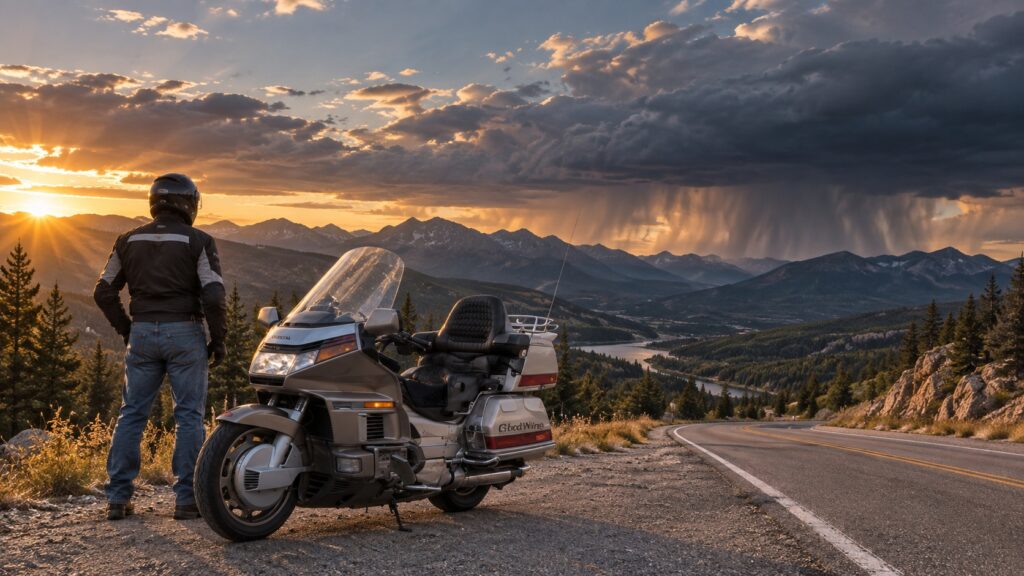
Fifteen hundred motorcycles rolled out of Woodland Park, Colorado, on a Saturday morning this summer, headed 26 miles down the road to Cripple Creek. I was somewhere in the middle of the pack on my 1988 Honda Gold Wing GL1500, a bike I’ve kept running well past 100,000 miles, riding alongside everything from something barely bigger than a scooter, to big trikes, to brand-new bikes with automatic transmissions, to machines older than mine that somebody had clearly kept alive the same stubborn way I’ve kept mine alive. If you wanted one photograph of how many different ways there are to get down the same road, that procession was it.
We were riding for the POW/MIA cause, honoring soldiers who were captured or never came home. People lined the highway the whole way to Cripple Creek, holding signs that said thank you for your service. Somewhere around mile 10, with nothing between me and the road but a helmet and a jacket, I found myself turning over something that had nothing directly to do with the ride at all. Watching that many people willing to stand on a hot roadside and thank strangers for a kind of risk and commitment most of us will never come close to got me thinking about risk and commitment on a much smaller scale, the kind you take on when you start a small business instead of drawing a paycheck.
Real entrepreneurs don’t take that kind of risk because they love risk. They take it because they’ve calculated it, decided it’s worth it, and accepted the consequences with their eyes open. That’s a different thing entirely from recklessness, and it’s a different thing from comfort too. More and more, comfort is what gets handed to people whether they ask for it or not, quietly, by default, before most of them ever notice there was a choice to make at all. That’s really where this whole piece started, somewhere on the highway with the throttle in my right hand. This isn’t a story about the ride itself. It’s a story about a choice that’s disappearing faster than most people realize, and about the ones who go looking for it anyway.
Riding with me that day was Gregg, a client of mine; everyone knows him as 3G. This wasn’t supposed to be his first ride with me. He was set to join me and my son Josh on one of our recent runs up to Sturgis, but he had to cancel at the last minute after his father had a heart attack. Gregg flew home instead of riding north with us. So, when the POW/MIA ride came around and he could make it, I made sure he came along.
We stopped for lunch in Cripple Creek, and I asked him how the school was coming along. Gregg has spent close to 10 years running a business called AutoShop Vocational, mostly ad hoc the whole time, working out the curriculum, proving the concept in pieces, taking on odd jobs on the side to keep cash flowing. At the same time, he built the thing he actually wanted to build. Now he’s finally at the point where he’s trying to make it permanent, lining up a sponsor to take it from proof of concept to an actual sustainable program.
I told him what he’d been doing, whether he called it that or not, was exactly right. Prove the smallest version of the idea first. Keep it alive on odd jobs and patience. Only go looking for real backing once you know the thing works. Business people love to talk about a minimum viable product like it’s a new idea. It isn’t. It’s just patience with a deadline nobody’s set for you yet. Gregg didn’t need me to tell him this, not really. He gave me the kind of nod that means someone already knows something is true about their own life; they just hadn’t said it out loud in quite those words before.
I’ve made about 10 trips to Sturgis over the years, most of them with my son Josh riding beside me. As 3G and I prepared to ride home from Cripple Creek that day, I pulled up the weather on my phone before we left. A line of storms was rolling through, with another one stacked up behind it. I told Gregg it probably didn’t matter much when we left; we were getting wet either way. We ended up riding the back edge of the first storm with the second one still building behind us. We were lucky that afternoon, just wet roads and a few sprinkles for part of the way home, nothing worse than that.
That’s about as easy as weather gets on a bike. Sturgis in August is a different animal. Hail up there in the summer is common enough that you plan around it instead of hoping to avoid it. You watch the sky, and you know which overpass or stand of trees is close enough to duck under. Some years, you just wait a storm out under a bridge with a dozen other riders doing the same thing. None of that is recklessness. It’s closer to the opposite: reading the conditions carefully enough to know which risk is worth taking and which one is worth sitting out.
One night at a rally a few years back, I sat down with a handful of other riders and asked what they all did for a living. Nearly every one of them said they owned a small business. Some of that is simple economics. A cruiser bike in this class isn’t cheap, and neither is a stay in or around Sturgis during rally week. There aren’t many minimum-wage jobs that leave room in the budget for a trip like that. But I don’t think it’s only the money. I think the same thing that makes someone comfortable with the added risk of riding into weather they can’t fully control is the same thing that makes them comfortable running a business they can’t fully control either. Not recklessness. A working relationship with risk: deciding what’s worth riding into and what’s worth waiting out, and trusting yourself to tell the difference.
The Gold Wing and that storm are one kind of risk, the kind that I equate with being self-employed. You’re exposed. There’s no crumple zone if it goes wrong, no steel cage around you, and no guarantee the car merging next to you has actually seen you. But it’s just you making the call, and the road, whatever’s coming at you, is at least a known road.
I’ve got a second bike, a Kawasaki KLR 650, built for something rougher, and riding it feels closer to what running a small business with employees is like instead of just yourself. Nobody made me swap one for the other. I chose to take on more risk once I’d calculated it was worth it, the same way anyone chooses to hire their first employee instead of staying solo and calling it safer.
There’s no set path on a dual-sport ride, only wherever the terrain lets you go: gullies, sudden drop-offs, rain-carved ruts that showed up since the last time somebody rode through there, and what riders call whoops. You carry more caution out there, and more gear, because more can go wrong and because other people are counting on you getting home in one piece. I pack spare brake and clutch levers, a tube of JB Weld in case something cracks, a space blanket, a water filter, a compass, and several other survival supplies, because it’s entirely possible to break down somewhere with no cell signal. In many cases, especially when riding alone, nobody’s coming unless I get myself out. I even carry a tiny stove, because on a good trip, I might forage for something along the way, whatever’s in season, and cook it myself instead of packing every meal in. In the worst case, I’m prepared to survive the night until help arrives, or walk out under my own power.
That’s what running a business with people depending on you actually feels like. It’s not that the stakes are higher because you’re braver. It’s that when something goes wrong out there, or in a business with a payroll, it isn’t only your own risk anymore, and you’d better have already thought through how everyone gets home. The riding gear changes too. On the Gold Wing it’s standard road gear: a jacket, gloves, a full-face helmet. On the KLR I sometimes add a chest protector, extra armor, and motocross-style pants reinforced at the knees and hips, because the terrain hits harder and more randomly than a wet interstate ever will.
On the upside, riding the KLR also means seeing things a car, or even the Gold Wing on pavement, never will. I recall a stretch along a fire road where wild berries grow along the edges in season. Most drivers on these roads blow past them without ever knowing they’re there. Moreover, I know a handful of high mountain lakes you can only reach on two wheels and a lot of patience, where I’ve stood on the shore casting my tenkara fly rod, which I often carry on these excursions, to catch trout few others ever fish for. I’ve ridden to remote ghost towns that don’t show up on any map worth trusting, just a few collapsed buildings and a hundred years of silence.
None of that is available to someone sealed inside an air-conditioned cabin with the windows up and the radio on. The field of view on a motorcycle is unobstructed: no roof, no pillar blocking the corner of your eye, nothing between you and the actual air, thin and cold in the mountains in a way that’s completely different from how it feels at lower elevation in August. You notice more because there’s nothing between you and what’s actually there to notice.
That’s true in business too. The owner who’s actually in the field, talking to customers, watching how people really use the product, notices the small opportunity sitting in plain sight: the tweak nobody asked for that turns out to matter, the complaint that actually becomes your next product idea. The person sealed off in a cabin, whether that cabin is a car or a corner office, drives right past all of it without ever knowing it was there.
Riding a motorcycle, whichever one, means running the whole machine yourself: clutch, throttle, brakes, balance, judgment, all of it, continuously, with nothing standing between your decision and the outcome. That’s what it actually means to own your work. Drive a car, and you’ve already handed a share of that over, especially if it’s an automatic. The transmission decides for you, and you’re a step removed from the machine even though you’re still the one steering it. That’s closer to what it’s like to be an employee. You’re present, you’re responsible for your piece, but a system is quietly making decisions you used to have to make yourself.
My wife’s car takes that further still. It’ll warn you if you drift out of your lane, a vibration in the steering wheel. If you let it, it’ll also gently nudge you back into the lane on its own, a soft correction, not a self-driving car taking over. It’s just enough help that you can get lazier about staying centered than you used to be able to afford to. Radar watches every side of the car and will brake for you if something gets too close while you’re backing out of a space, for example. Adaptive cruise control makes her car slow down when traffic slows and speed back up on its own once the road clears. None of that is a computer doing your job. It’s a computer catching your mistakes before they become expensive.
Somewhere past that is a car with no steering wheel at all, a robo-taxi you sit in without ever touching a single control, where the decision was never yours to begin with. That’s what fully AI-mediated work looks like. We’re not there yet in most of what we do, but the direction is obvious enough. Riding a motorcycle sits at the opposite end of that whole spectrum, on purpose. And it’s worth saying plainly: that opposite end is getting smaller. Motorcycles are increasingly sold as automatics now, like semi-trucks and most cars and trucks on the road. The choice to stay actively engaged with the machine instead of letting it manage you isn’t gone, but it’s not the default anymore either. Fewer people ever get handed that choice at all. That’s the distinction worth holding onto: reckless means skipping the calculation, not skipping the comfort. What’s actually disappearing isn’t safety. It’s the chance to run the calculation yourself before somebody, or something, runs it for you.
Gregg’s business is still ahead of him: the sponsor conversation, the leap from proof of concept to something permanent. But he’s spent almost 10 years proving the thing works before asking anyone to bet real money on it, and that’s exactly the order it’s supposed to go in. I told him that over lunch, and I’ll say it here too. The model was always sound. It just needed time.
As for me, I’m still riding a 37-year-old motorcycle with more than 100,000 miles on it, not because it’s practical and not out of nostalgia. I ride it because running the whole machine myself, feeling the clutch, working the gears, staying that engaged with what I’m doing, is the actual point, on two wheels and in business too. It’s the same calculated risk I started this piece with: not reckless, just decided, with my eyes open, over and over again. Fewer people get offered that choice every year, in a machine or in a career. I’d rather keep taking it while it’s still mine to take.
Where in your own life has the comfortable path already been chosen for you, quietly, without you ever running the calculation yourself, and what would it take to take the wheel back?