I’ll be direct about something personal before getting into the framework.
There are days I sit down at my desk at 9:00 a.m. to work on a blog post or a chapter of my book, and the next thing I know, it’s 1 p.m., and my wife is standing in the doorway asking me if I ever planned on eating lunch. I didn’t forget. The meal never registered. I was locked in. Completely. Somewhere in the work, time stopped being a thing I tracked.
For years, I thought that was a quirk. Maybe a flaw. Something to manage.
I don’t think that anymore.
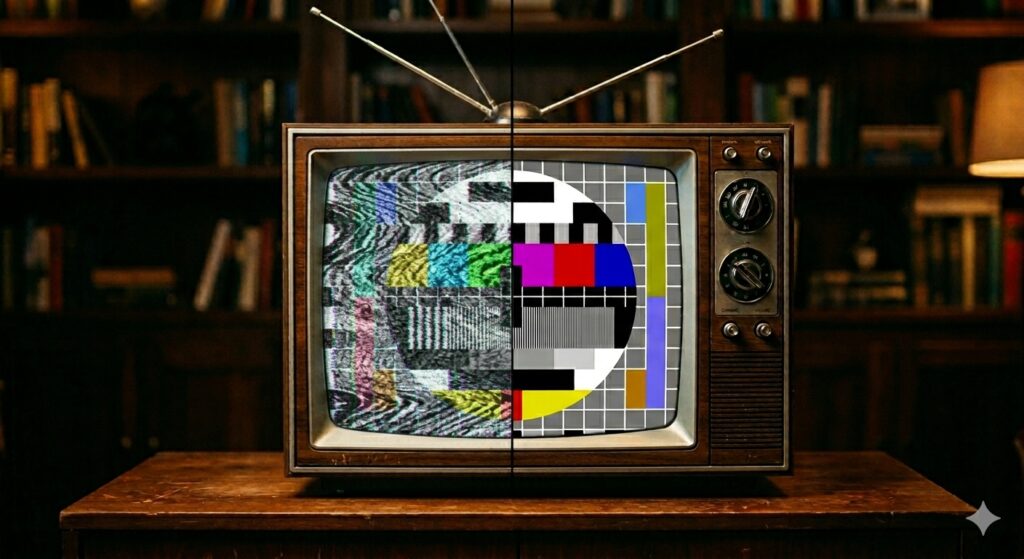
Signal vs. Noise – The Real Version
There’s a concept from engineering called signal-to-noise ratio. Signal is the meaningful information you’re trying to receive. Noise is everything else competing for bandwidth. A high signal-to-noise ratio means the message gets through clean. A low one means the static wins.
Applied to your business day, the signal is what you actually need to accomplish. The specific things, if done with focus and intention, that move the business forward. Noise is everything else landing on your desk, your phone, your attention.
Most productivity advice tells you to filter the noise better. Block your calendar. Turn off notifications. Close the browser tabs.
That’s fine advice. But it misses the deeper question: what happens when your brain is already built to filter noise? What happens when focus isn’t a discipline you practice but a state you fall into? And what do you do when the people around you experience your superpower as abandonment?
You Might Be Wired as a Hunter
Thom Hartmann, in his book The Edison Gene, laid out a theory that reframes a lot of this. ADHD isn’t a disease, disorder, or defect. It’s an inherited trait that served hunter-gatherer ancestors well for hundreds of thousands of years.
Hartmann argues that hyperfocus is the hunter’s primary tool. When the prey is in sight, the hunter enters a state of total immersion where time disappears. That’s not a malfunction. That’s the system working exactly as designed. For the better part of human history, the ability to lock onto a target and block out everything else was the difference between eating and not eating. Medium
In the context of hunter-gatherer societies, the traits associated with ADHD: novelty seeking, impulsivity, and a heightened state of alertness, likely offered considerable adaptive advantages. The impulsivity and quick adaptability, often viewed as drawbacks in modern structured settings, could have enabled rapid decision-making and immediate action in environments where such responsiveness was crucial.
The problem isn’t the hunter. The problem is the environment. ADHD has a global prevalence of 5 to 7 percent, a trait preserved for millennia, suggesting a possible evolutionary advantage somewhere. You don’t preserve a trait that long unless it’s working.
What stopped working is the context. School, 9-to-5 schedules, open offices, and back-to-back meetings are designed for a different kind of brain. Thom Hartmann argues that children who possess ADHD characteristics are neurologically wired to give them brilliant success as innovators, inventors, explorers, and entrepreneurs. The research backs that up. The risk-taking and drive for stimulation in ADHD can be channeled into entrepreneurship, where one can create a dynamic work environment that suits fluctuating focus and energy levels.
Entrepreneurship, in a real sense, is just hunting with a business license.
What Color Is Your Time?
A few years back, one of my mentees, Gregg “3G” Sheldon, founder of AutoShop Vocational, opened a conversation with a question I’d never heard before. Before asking his question, he asked: “What color is your time?”
The idea comes from communications expert Leil Lowndes, who in her book How to Talk to Anyone describes asking “What color is your time?” as a respectful way of asking “Is this a good time to talk?” It acknowledges that not all time is equal, and that interrupting someone mid-focus carries a real cost.
Green means you’re open and available, nothing critical in play. Blue means you’re with someone but can be interrupted if genuinely necessary. Yellow is light caution; you’re working on something important, but can pause for a few minutes if something important comes up. Orange means you’re in focused work mode; interruptions should be limited to genuine urgent matters only. Red means that you are in full-on signal mode, you’re doing your most important work, and don’t interrupt me unless something is actually on fire.
For most people, this functions as a simple communication tool. A way to signal availability to a team, a spouse, or a business partner without having to explain yourself every time.
For hunters, it’s something more. It’s a language for explaining a state that otherwise looks, from the outside, like indifference.
Jobs and Musk Weren’t Nice About It Either
Steve Jobs didn’t apologize for his focus. He spent days agonizing over just how rounded the corners should be on a product case, and when the Pantone company offered over two thousand shades of beige, none of them were good enough. That level of signal lock-in doesn’t coexist easily with being present at the dinner table. It was never designed to.
Walter Isaacson, who wrote biographies of both Jobs and Musk, observed that with both of them, the bad behavior and the brilliance come as a package that cannot be separated.
Musk almost lived in the office during the Zip2 years. Eating, sleeping, and bathing there. During Tesla’s early days, he sometimes worked 120 hours a week. Multiple marriages. Fractured relationships. Larry Ellison described both Jobs and Musk as having beneficial cases of obsessive-compulsive disorder, saying OCD was one of the reasons for their success because they obsessed on solving a problem until they did.
This is not a defense of treating people badly. It’s an honest accounting of what the signal state costs, and what it produces.
The Frustration Is Real. So Is the Drive.
Here’s the part that doesn’t get said in polite company.
When I’m in signal state, deep in writing, locked onto a client problem, tracking something that matters, and someone pulls me out to attend my grandson’s sporting event or respond to a text that could wait, there’s friction. Real friction. Not because I don’t love the people involved. I do. But because breaking the signal doesn’t just pause the work. It collapses the state. Getting back in can take an hour. Sometimes it doesn’t come back that day at all.
That loss is real. And the drive to protect the signal, to finish the day’s work, to complete the hunt, is not a personality defect. It’s biology. It’s tens of thousands of years of wiring saying: stay on the prey.
The farmer’s world tells you to feel guilty about that. I’d push back on that.
What I’ve learned is this: the people in your life don’t need all of your time. They need real presence when you give them your time. A hunter who has finished the hunt and comes home is fully home. That’s different from someone who shows up physically but never actually arrives.
The Framework in Practice
Three things that actually help.
Name your signal hours and communicate them in color. Not as a wall but as a frame. “From seven to noon, I’m orange or red. After noon, I’m green.” Most people who care about you would rather have a defined window of real presence than a full day of divided attention. Use the color system. It gives people a language to work with instead of guessing. Thanks, 3G.
Point yourself at the right thing before you go deep. Hyperfocus is non-discriminating. It’ll work just as hard on a low-value rabbit hole as on your highest-leverage task. The state doesn’t care. But a hunter who sets out without knowing what they’re tracking wastes the gift. Ten minutes of intentional signal selection before you go deep is the highest-leverage move you can make all day.
Stop calling the wiring a problem. Fields that require quick thinking, creativity, pattern recognition, and the ability to handle multiple threads simultaneously, fields like entrepreneurship, tend to attract people whose brains were never going to be comfortable in a cubicle. Whether that’s dyslexia, ADHD, some other form of neurodivergence, or simply a cognitive style that never fit the mold, the trait is the same: you process the world differently than the system expected you to.
You didn’t end up in business by accident. You ended up there because a structured environment with a boss and a schedule and a performance review cycle was slowly killing something in you. The hunt called. You answered.
That’s not a disorder. That’s a design match.
Are you being forced to suppress your hunter-gatherer instincts?