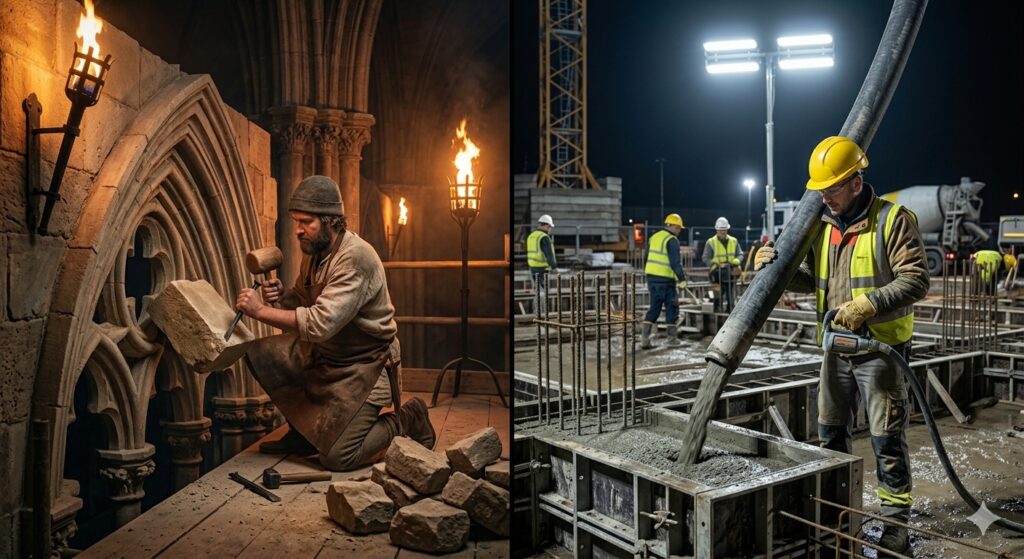
Every small business owner I talk to right now is making the same decision. They’re looking at AI tools that can do in minutes what used to take hours. They’re asking why they’d hire a junior employee to handle research, write first drafts, or support customers when a $20-a-month subscription can cover it. The economics are obvious. The logic is airtight.
That’s exactly the reasoning that ended 800 years of master craftsmanship, and gave us buildings that start failing after 50 years.
Stay with me. This isn’t a detour into history. It’s a pattern that has played out before, and understanding it may be one of the most important strategic decisions you make about how you build your business in the next decade.
When We Knew How to Build
Between roughly 1150 and 1500 CE, the great Gothic cathedrals went up across Europe. Notre-Dame de Paris. Chartres. Canterbury. Cologne. Most people look at them and see architecture. I look at them and see a knowledge management system that ran for 350 years and abruptly ended.
Stonemasons organized into guilds with a strict three-tier hierarchy: apprentices, journeymen, and master masons. The apprentice lived and worked in the lodge, the temporary structure built on-site during construction, and spent years absorbing everything the journeyman above him knew. The journeyman had absorbed it from a master. The master from the master before him.
They weren’t just passing down how to cut stone. They were transmitting the chemistry of quick lime mortar, the geometry of flying buttresses, the physics of load distribution, and the art of reading natural fault lines in stone. Centuries of refined knowledge, passed from person to person, requiring real time and real stakes. No shortcuts. No substitutes.
My Dad Was a Mason
My dad was a Mason, not a stonemason, but a Freemason, the fraternal organization represented by the square and compass symbol. My uncle went further, eventually becoming Grand Master of the Grand Lodge of New York, about as high as you can go in that world. Growing up, I’d spot the symbol on my dad’s ring and other articles and wonder what it really meant. Neither of them talked much about what it was to be a Mason. It was a brotherhood they clearly valued, but the details stayed rather private.
Recently, I was watching a documentary about the great cathedrals of Europe, and that symbol on my dad’s ring flashed right back into my head. I kept watching, and the more I learned about how stonemasons organized, transferred knowledge, and ultimately lost it all, the more I couldn’t help but see the connections to modern-day artificial intelligence. I had to write this down because what I found is a warning every small business owner needs to hear.
The Collapse That Wasn’t About Skill
Here’s what most people miss about the end of the cathedral era. It didn’t end because something better came along. It ended because the money dried up.
The Catholic Church’s wealth peaked in the 13th and 14th centuries. As that wealth contracted through wars, plague, the Reformation, and shifting political alliances, the cathedral commissions stopped coming. No commissions meant no lodges. No lodges meant the apprenticeship chain broke. Masters died without passing on what they knew. The expertise didn’t become obsolete. It became inaccessible. Nobody decided stonemason knowledge wasn’t valuable. The economic system that funded its preservation simply stopped paying for it.
That last sentence should stop every small business owner cold. Because it’s exactly what’s happening right now.
When businesses choose AI over entry-level hires because it’s cheaper, they aren’t just making a staffing decision. They’re defunding the mechanism that creates expertise. The junior analyst role, the assistant copywriter, the entry-level account coordinator, these weren’t just cheap labor. They were lodges. Spaces where people absorbed tacit knowledge from the professionals above them, developed judgment through real work, and built the foundation for mastery. When those roles disappear because AI is cheaper, the chain breaks. There’s nobody left to become the senior. And eventually, nobody actually knows how to do the work behind the outputs.
We cannot build a Gothic cathedral today. Not for lack of ambition or money. Because the knowledge is simply gone. In 20 years, entire professions may face the same reckoning.
Portland Cement: Cheaper, Simpler, and Built to Fail
What replaced the master stonemasons? Portland cement. Rebar. Poured concrete.
Portland cement wasn’t faster; skilled masons could lay several courses of stone in a day. The real advantages were economic and logistical. It was cheaper. It could be packaged and shipped. It didn’t require years of specialized training to use.
Quick lime, the mortar of the cathedral builders, created a chemical reaction when mixed with water that produced intense heat, enough to burn skin on contact. It demanded careful, experienced handling. Portland cement was safer, simpler, and infinitely more scalable. You didn’t need a master. You needed a laborer and a form.
And Portland cement delivered. It became the foundation of modern construction in every sense, not just poured footings, but structural walls, floor slabs, bridge decks, highway overpasses, parking garages, and high-rise frames. Anywhere a load needed to be carried, concrete with rebar became the answer. The entire modern world is built on it.
But here’s what that trade actually cost. Quick lime mortar is self-healing; it slowly re-carbonates over time, filling micro-cracks before they lead to structural failure.
Portland cement doesn’t. Those micro-cracks stay open, and over time, water gets in. Water reaches the rebar. The rebar rusts. And when rebar rusts, it expands, cracking the concrete from the inside out. The very reinforcement added to make structures stronger is the mechanism that eventually destroys them. It doesn’t matter whether it’s a bridge, a parking deck, or a high-rise – the failure starts invisibly, deep inside, long before anyone sees a problem. A well-built concrete structure lasts decades. A cathedral like Chartres has been standing for 850 years.
That’s not innovation. It’s cost reduction dressed up as progress. Short-term gain, long-term fragility, baked right into the material. It’s the same story Wall Street tells every quarter: optimize for this period, externalize the long-term costs, and let someone else worry about the rebar when it starts to rust.
AI is shaping up to become the Portland cement of knowledge work. The economics are compelling right now. The fragility gets quietly embedded, and you won’t notice it until something cracks from within.
Reading Architectural Digest to Run a Division
Years ago, when I worked at Digital Equipment Corporation, I had a boss named Ron Brown. Ron was genuinely unconventional in how he thought – not as a cliche, but in practice.
One day, he rolled out an org structure unlike anything I’d seen. It broke conventional hierarchy in ways that made complete sense once you understood it, but didn’t follow any standard playbook. I was sitting in his office and asked where the idea came from.
He said he came up with it after reading an article in Architectural Digest.
I probably stared at him for a second. Architectural Digest? He smiled and explained: he wasn’t reading it for the architecture. He was reading it because ideas from completely unrelated fields solve problems that conventional sources have stopped seeing clearly. When you only read what your peers read, you only think what your peers think.
That conversation stuck with me. And it’s exactly what happened when I watched that documentary about Gothic cathedrals. I wasn’t looking for a business insight. I was just curious. But the more I learned about how those master stonemasons actually worked, the more serendipitous connections kept surfacing.
What made those builders extraordinary wasn’t expertise in a single craft. It was the ability to draw from many disciplines at once and see how they fit together. They understood the chemistry of quick lime; how it reacted with water, how it cured, how to handle a material that could burn through skin if you weren’t careful. They understood the geometry of arches and vaults well enough to redirect enormous structural loads downward without a single steel beam. They knew how to read stone for natural fault lines before cutting it. And some of these cathedrals were built on boggy, unstable ground using networks of wooden piers driven deep into the earth, a foundation solution that predated anything we’d recognize as modern structural analysis. None of it came from one place. It came from generations of accumulated knowledge across chemistry, geometry, materials, and soil, and the willingness to see how those things connected to each other.
That’s the same instinct Ron Brown was using when he read Architectural Digest. Spotting a connection nobody else had thought to make because nobody else was looking in that direction. It’s serendipitous thinking taken seriously, and it’s one of the most undervalued capabilities in business.
This is exactly where AI falls short right now. AI is extraordinarily good at retrieving and recombining what already exists within a domain. What it doesn’t do is watch a documentary about medieval stonemasons and come back with a warning for small business owners. That kind of synthesis requires the accumulated experience of someone who has lived in multiple worlds, developed the instinct to recognize a pattern when it shows up in an unexpected place, and has the curiosity to follow the thread wherever it leads.
That’s the competitive advantage AI cannot easily replicate. Not speed. Not volume. The ability to connect things that haven’t been connected before, and know why it works.
AI Is Pouring Portland Cement
Think back to those apprentices in the lodge. A 14-year-old would leave home, move onto the construction site, and trade his labor for a bed, a meal, and an education. No wages. No tuition. Just years of watching, assisting, and slowly absorbing what the journeyman above him knew. The lodge wasn’t just where they slept, it was the entire knowledge transfer system, and it ran on time and proximity rather than money.
In The Quiet Disruption, I wrote about the collapse of the apprenticeship ladder as one of AI’s four key vectors of disruption. Entry-level cognitive roles, including research, writing, analysis, and client support, are being displaced faster than any previous technology shift. And unlike past automation, this isn’t replacing physical or repetitive labor. It’s replacing the work that used to teach people how to think.
The entry-level roles were the modern equivalent of living in the lodge. The junior analyst wasn’t just cheap output. They were learning how the senior partner’s mind worked; what questions to ask before answering, how to know when the analysis is lying, when to trust instinct over the data in front of you. That knowledge doesn’t transfer through a job description. It transfers through proximity, mentorship, and time.
Remove the lodges, and in a generation, you’ve removed the masters.
In After the Paycheck, I explore the second- and third-order consequences of this shift, not just the job losses, but the structural fragility that accumulates when the pipeline to mastery disappears. The issue isn’t automation. The issue is what we are trading away without realizing it.
The Verification Problem
The stonemasons’ secret signs solved a real authentication problem: how do you prove your knowledge is genuine in a world without formal credentials? A master mason arriving in a new city needed a way to verify himself to a foreman who’d never met him. The system included specific handshake grips, spoken passwords, ritual phrases, and physical signs. A layered set of signals that would be nearly impossible for an outsider to fake without having actually lived inside the lodge system. Each element of the exchange confirmed not just identity but standing. Whether you were an apprentice, a journeyman, or a master mattered, and the signs made that distinction clear to anyone who knew how to read them.
We face the opposite problem today. The question isn’t whether something was created by a human or a machine; it’s whether what we’re looking at is true at all. AI can generate images, videos, audio, and written content that are indistinguishable from reality. A quote from someone who never said it. A research summary that sounds authoritative but is pure pattern-matching; assembled not to inform, but to persuade, and calibrated to be convincing enough that you never question the source.
The intent behind a lot of this synthetic content is often manipulation dressed up as information, and AI has made it incredibly easy to produce and nearly impossible to identify. The downstream effect is the erosion of trust. When you can’t reliably tell what’s real, you start doubting everything: the article, the video, the quote, the review, the data behind the recommendation.
The stonemasons built their verification system because trust had to be earned and credentials had to mean something. We’re moving in the opposite direction, and the damage accumulates quietly until the moment it doesn’t.
The Freemasons preserved those signs and rituals long after the original purpose was gone. My dad’s generation knew why they mattered, but they mattered for brotherhood and belonging, not for verifying anyone could calculate a load-bearing arch. The credential became ceremony. The form survived. The function quietly changed underneath it.
That’s exactly the pattern showing up in professional expertise today. The titles remain: analyst, strategist, consultant, but the development systems that gave those titles meaning are being quietly dismantled. We’re keeping the form while hollowing out the substance.
What This Means for Your Business
The small business owners who navigate this well won’t be the ones who adopt AI most aggressively. They’ll be the ones who use it most deliberately.
If you’re replacing entry-level apprentice jobs with AI tools to cut costs, you’re making a Portland cement decision. It makes sense on the spreadsheet today. It embeds fragility into your operation for tomorrow. The capability you’re not building now is the rebar that will crack when you actually need it.
If AI is displacing the entry-level work in your industry, your own expertise has a pricing problem on the horizon. The market will increasingly pay for outputs, and AI produces cheap outputs. The businesses that survive will be the ones that can clearly demonstrate and charge for what AI cannot replicate: judgment earned from real experience, relationships built on real trust, and the ability to understand a situation rather than pattern-match against historical data.
And if you want to know where your next competitive insight comes from, try reading something completely outside your industry. Ron Brown found an organizational breakthrough in a design magazine. The stonemasons built knowledge systems that outlasted empires. Both understood something most people miss: the most durable advantage you can build is one that took real time and real mastery to create.
Cathedrals like Chartres are still standing. The parking garage or retaining wall built in 1975 is crumbling. Both were built to solve a problem. Only one was built to last.
Are you building with quick lime or Portland cement right now and do you know the difference?