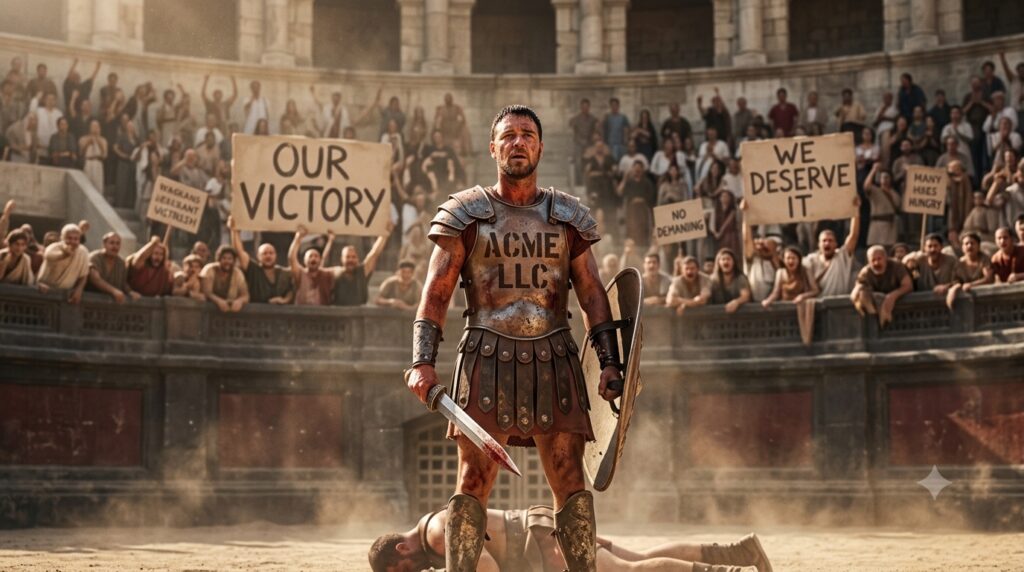
I was watching footage of a crowd protesting outside a company headquarters last week. Signs everywhere. The message was simple: the workers built this; the workers deserve it; the owner is just sitting on their backs, collecting what isn’t his.
I get the emotion behind it. I don’t get the math.
I’ve heard that math before, up close. Years ago, when I was running my first employer-based company, one of my writers asked to speak with me privately. She got straight to the point. “I don’t know how you sleep at night,” she said. “You pay me $20 an hour and charge the client $65. That’s $45 an hour of profit off my labor.” She had the numbers right. I paid her about $40,000 a year, close to $20 an hour, and billed her time out at $65. On paper, a $45 margin made it into my pocket every hour she worked.
What she couldn’t see was how we spent that margin. The office she worked in. The furniture and the office equipment she used. The computers and the IT support that kept them running. The utilities that kept the lights and the heat on. Every sales call and marketing dollar that turned her hours into a paycheck instead of wasted time. And there were many more expenses, none of which showed up in her math, because none of them was ever visible from her side of the desk.
And she had no idea about the part that mattered most: For many pay cycles, I wasn’t taking a paycheck at all. The $45 she thought I was profiting from her efforts every hour wasn’t going into my pocket at all. It was going everywhere else, just to keep the doors open long enough for her to keep getting paid.
That conversation, and the years like it, are exactly the episodes the crowd outside the building never sees. Every person holding one of those signs at that protest was watching episode 40 of a story. They never saw episodes one through 39. And in this story, those missing episodes are the only part that explains how episode 40 even exists.
The Movie Everyone Walks In Late For
Here’s the thing about success. It’s the only part of the story anyone bothers to watch. Nobody shows up to protest a failed business. Nobody pickets a guy who mortgaged his house, hired four people, and, 18 months later, closed the doors, owing money to everyone he knows. That story doesn’t make the news. It doesn’t make a crowd. It just makes a quiet, expensive lesson that gets buried and never talked about again.
But that failed business, or three of them, is usually the prequel to the one that worked. I didn’t wake up one day with 30 employees and a profitable company. I woke up plenty of days with nothing. I had ventures that ate my savings and gave nothing back. I had years where I covered payroll out of pocket because the receivables hadn’t come in yet, and if they never came in, that was my problem, not anyone else’s. Nobody was protesting on my behalf those years, because there was nothing to protest. There was just risk, sitting on my shoulders alone, every single day.
That’s the part the crowd outside the building never sees. They walked into the theater at the part where the popcorn’s already popped, and the seats are full, and they think that’s where the movie started.
The Theory That Sounds Fair Until You Check the Math
The argument underneath all of this is something economists call the labor theory of value. Workers produce the output, so they should own it. Simple, clean, sounds fair on a protest sign.
Except it skips a step. Output doesn’t exist in a vacuum, waiting for labor to show up and unlock it. Output exists because somebody built a structure for that labor to operate inside. The customer relationships that make the work valuable. The positioning that makes the product something people will pay for instead of ignoring. The capital that covered the lights, the inventory, the insurance, the tools, months before a single sale happened. The decision, made under real uncertainty, to hire person one, then person two, then person 30, when there was no guarantee any of them would have a job in six months.
Take away that structure and the exact same 30 people, doing the exact same skilled work, produce nothing. No customers. No revenue. No paycheck. The labor didn’t change. The structure around it disappeared, and the value disappeared with it.
That’s not a knock on labor. Labor is essential; every business needs it. Good employees are worth protecting and paying well. But “essential” and “the sole source of value” are two different claims, and the protest sign only ever makes the second one.
An Analogy Most People Can Actually Feel
Think about a farmer who spends years building irrigation, terracing the land, testing which crops survive the local frost, and going broke twice before figuring out what actually grows there. Eventually, the land produces a harvest big enough that he needs to hire pickers.
The pickers show up at harvest. They do real work, hard work, and they deserve fair pay for it. But imagine someone walks up to that field during the one good harvest and says the land belongs to the pickers, because they’re the ones who touched the crop. Nobody asks where the irrigation came from. Nobody asks about the two seasons that failed, the debt that paid for the terracing, the years the farmer worked the land alone, with no harvest at all.
The pickers showed up for the harvest. The farmer showed up for the harvest, and every losing season before it. Both kinds of work matter. They are not the same kind of risk, and they were never going to be paid the same way.
The Risk Nobody Wants to Carry, Only Split
Here’s the asymmetry that gets erased every time this argument comes up. Employees show up, do the job, get paid on schedule, and walk away clean if the business fails. That’s not a criticism, it’s the deal, and most people rationally prefer that deal. Fixed work, fixed pay, no exposure.
The owner doesn’t get that deal. The owner eats the loss alone if it doesn’t work and only gets the upside if it does, with every other obligation paid first. Payroll goes out before profit does. So does rent. So do the suppliers. The owner is last in line every time, for years, often for a paycheck smaller than that of the people they employ.
People who’ve never run that gauntlet tend to assume the money was just always there, waiting to be divided more fairly. It wasn’t. Most of it didn’t exist until someone took on a risk nobody else in the building was willing to take on. That’s not exploitation. That’s the actual trade. You can disagree with how the trade is structured in a given industry; that’s a fair conversation, but you can’t pretend the risk wasn’t carried by somebody, alone, for a long time.
What the Paycheck Doesn’t Show
There’s another piece of this that almost never makes it into the conversation. The employee’s paycheck looks the same whether the business made money that month or lost it. That’s the whole point of being an employee, and there’s nothing wrong with wanting that. But it means the paycheck is silent about the thing that actually determines whether there will be a business to work for next year.
An owner watches a different number every month: what’s left over after everyone else gets paid. Some months, that number is negative, and the owner covers it personally because payroll isn’t optional and the lights don’t turn themselves off. But the people getting paid that month never see it. They don’t see the spreadsheet where the owner decided whether to make payroll or pay themselves, and chose payroll, again.
This isn’t a complaint about employees. Most employees would make the same call if the roles were reversed, choosing the stability of a fixed paycheck over the volatility of ownership. That’s a rational choice, and a perfectly fine one. The point is just that it’s a different choice, with a different risk profile attached, and the rewards downstream of it were never going to be identical. You can’t take the stability of one path and demand the upside of the other.
Theodore Roosevelt Said It Better Than I Can
There’s a passage from Theodore Roosevelt, often called “The Man in the Arena,” that’s worth reading:
“It is not the critic who counts; not the man who points out how the strong man stumbles, or where the doer of deeds could have done them better. The credit belongs to the man who is actually in the arena, whose face is marred by dust and sweat and blood; who strives valiantly; who errs, who comes short again and again, because there is no effort without error and shortcoming; but who does actually strive to do the deeds; who knows great enthusiasms, the great devotions; who spends himself in a worthy cause; who at the best knows in the end the triumph of high achievement, and who at the worst, if he fails, at least fails while daring greatly, so that his place shall never be with those cold and timid souls who know neither victory nor defeat.”
Theodore Roosevelt
That’s the entire argument in one image. The crowd outside the building has never been in the arena. They’ve never signed a personal guarantee on a loan. They’ve never laid off someone they liked because the numbers didn’t work. They’ve never had a year when their own paycheck was the last thing to get paid, if it got paid at all. They’re commenting on the fight from the bleachers, and they think that entitles them to redesign it.
Questions Worth Sitting With
If you’re an entrepreneur catching this kind of backlash, a few questions are worth running through your own head, not to win an argument with anyone else, but to get clear with yourself:
How many ventures did it take before one of them worked? Count them honestly. That number is your real tuition, and nobody refunds it.
Who was financially exposed during the years before this business turned a profit? If the honest answer is “just me,” that’s not something to apologize for.
Are the people criticizing the arrangement willing to trade places, with the risk included, not just the outcome? Most aren’t, and that’s fine, but it tells you something about whether the criticism is really about fairness or just about wanting the upside without the downside.
What would have happened to those 30 jobs if you hadn’t taken the risk in the first place? Somebody had to decide those jobs were worth creating before there was any proof they’d work. That decision is worth something, too.
You’re the Maker, Not the Spectator
If you’ve built something that employs people, you didn’t take from them. You built the thing that gave their labor somewhere to go. You absorbed years of risk most people will never volunteer for, and you’re still in the arena while the critics are in the bleachers explaining the fight to each other.
Keep building. The prequel nobody watched is still the most important part of the story, and you’re the only one who lived it.
The next time someone criticizes what you built without knowing what it cost you, how will you respond?