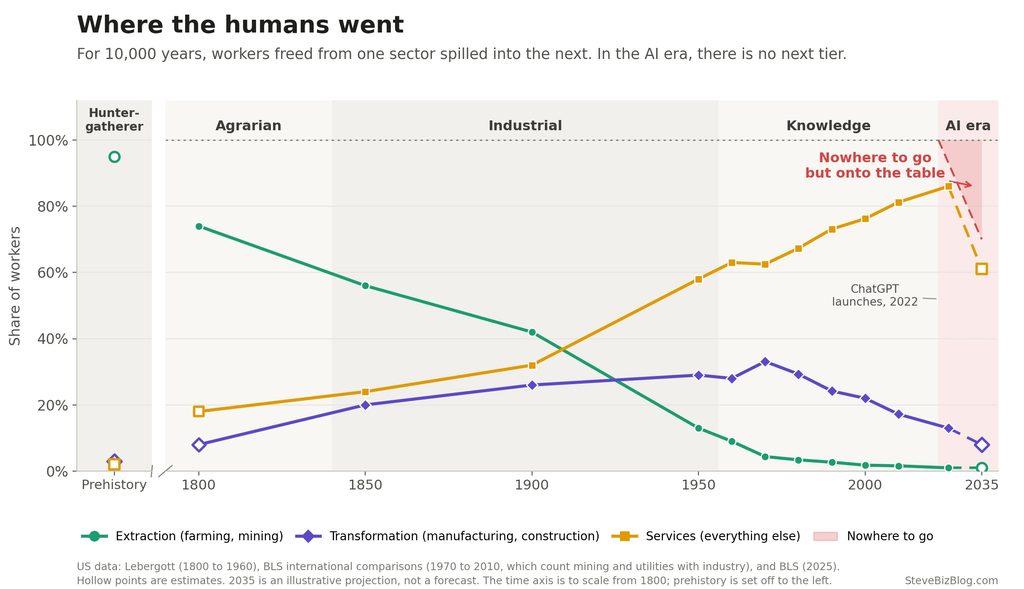
For 10,000 years, every time technology took people’s work, there was somewhere else to go. Farmers became factory workers. Factory workers became office workers. AI is the first technology that leaves nowhere left to go, and if you own a small business, that changes what your work is worth. I didn’t go looking for that idea. I stumbled into it.
One of the things I like to do is pick a topic I don’t know much about and research it until I understand it reasonably well. I’ve done it my whole life. Call it the polymath habit. Recently the topic was around geography, and more specifically how countries move from developing economies to advanced economies like the one we have in the United States.
Why do some countries stay mostly farmers for centuries while others race through the whole climb? In much of sub-Saharan Africa today, about half of all workers still farm, many of them on small plots growing mostly what their own families eat. Britain took the better part of two centuries to make the climb. South Korea did it in about two generations. In the early 1960s, most South Koreans farmed. Today it’s around one in twenty.
That research led me to the three-sector model, developed by economists Allan Fisher and Colin Clark in the 1930s and 1940s to describe how economies change as they grow. Right alongside it, I ran into something called Baumol’s cost disease. I’ll come back to that one, because it turns out to be the key to this whole thing.
Later that day, I went for a walk with my dog. Nietzsche said, “All truly great thoughts are conceived while walking.” I won’t claim this one was great, but it wouldn’t leave me alone. Fisher and Clark built their model when automation meant tractors and looms. Nobody was imagining machines that think. So, what happens to the model now, with the rise of AI? My brain started making connections, the way it always does, between this old economic model and the businesses I work with every week. Somewhere on that walk, I realized there’s a lesson entrepreneurs need to hear. A change is happening right now, and the old historical models are starting to break down.
So, if you’re a small business owner, stay with me. This isn’t an economics lecture. It’s about where your work’s value is going. If you read The One-Person Company, you’ll see where this connects.
Where the Idea Started: Three Sectors and Where Work Had to Happen
Textbooks call the three sectors primary, secondary, and tertiary. What caught my attention wasn’t the labels. It was the geography. Each kind of work had to happen in a certain kind of place. Farming and mining happen where the land and the ore are. Factories go where materials can come in, and goods can go out. Services go where the customers are. Where the work has to happen tells you a lot about who can do it, and that’s the thread I kept pulling.
The textbook labels don’t tell you much, though. Some economists have since added a fourth and even a fifth sector, but those are really services sliced more finely. I’m keeping it to three, and I’m giving them plainer names that say what actually happens: Extraction, Transformation, and Services.
Extraction
Extraction is taking what nature provides. Hunting, fishing, farming, mining, cutting timber, pumping crude oil out of the ground. If it comes from nature: the earth, water, or the forest, it’s extraction.
Because of that, people lived where the resources were. Settlements formed around the availability of game, fertile land, water, and ore. You didn’t get to choose where to live. Nature chose for you.
This is where every economy started. For most of human history, extraction was the only work. Nearly everyone hunted, fished, or foraged daily, and a few groups still live that way today, like the Hadza of Tanzania.
Transformation
Transformation is taking those raw materials, applying skill, energy, or a process, and producing something of greater value.
The simplest example is bread. A farmer extracts grain. A miller turns it into flour, and a baker combines that flour with yeast, salt, and water to make something worth far more than the grain. Most transformations work like that, combining several raw materials into one new thing.
Oil runs the other direction. Exploration and production (E&P) companies extract crude oil from the ground and ship it to a refinery. There, one raw material becomes many products: gasoline for our vehicles, heating oil for our homes, jet fuel, and the building blocks of plastic. Either way, the idea is the same. Raw materials, something applied to them, and a result of greater value.
Transformation has its own geographic constraints too. While it might be located near the source of the raw materials or near the customer, it almost always needs to be where transport works. First that meant rivers and coastlines where ships could bring materials in and carry goods out. Later it meant wherever the railroads ran, and later still wherever the interstates went.
However, being close to raw materials and customers, and near a route that connects them, is only part of the location decision. Labor and energy matter just as much. Transformation also migrates toward where labor and cheap energy are abundant. That’s a big part of why so much of it ended up in China starting in the latter part of the twentieth century. Chinese cities and towns are often organized as supply-chain hubs. One town might specialize in furniture. Skilled Labor, wood, fabric, and hardware suppliers all clustered around it. The next town over specializes in electronics, with all of its labor and suppliers around it. China drew this work because labor was abundant and cheap, and it built the power plants and ports to match.
Services
Services are work that produces nothing tangible and is delivered to people. Doctors, lawyers, teachers, healthcare workers, police and fire, salespeople, barbers, and on and on through the economy. When you pay for a service, you don’t walk away holding a thing. You walk away with something done for you.
Services also split into two kinds, and that difference matters a lot now that AI is here. Some services are done mainly with the mind. Think bookkeeping, law, or analysis. Other services rely mainly on the providers’ hands and presence. Think nursing, firefighting, or cutting hair. The mind-based side is where the knowledge worker comes in, a term Peter Drucker coined in 1959.
Historically, services had to be located with or right next to the people they served. Your doctor, your child’s daycare, and your barber all had to be in your town.
The internet broke that for many knowledge workers. Much of that mind work can now be done remotely, from anywhere. Some economists call this the quaternary sector, but I’m keeping it inside services. The key concept is simple: some services no longer needed providers to be near customers.
That split also holds another quiet business lesson. Hands-based services stayed tied to geography, the same way farms and factories always were. That tie worked like a fence. It kept the barber in, because a barber can only serve the people who walk through the door. But it also kept competitors out, because nobody across the country can take that customer. Mind-based services lost the fence. The internet gave them a bigger market and a lot more competitors. The fence that hems you in is often the same one that keeps competitors out.
Now let’s run the sequence, because this is where the model comes alive.
We started as hunter-gatherers, where extraction was everybody’s job, or the tribe starved.
Then came the agrarian era with its specialization. Farmers learned to grow more food than their own families could consume, which meant they could sell or trade the surplus. That surplus freed other people from having to pull their own food from nature. Now someone could specialize in making bread. Someone else could make pots and bowls, or tools. Artisans appeared, and transformation was born. The same surplus also supported early services: merchants, priests, scribes, soldiers. For the first time, people weren’t all committed to extracting what they needed from nature.
The industrial era brought machines, and people moved from farms to factories. Then, as the factories automated, people migrated again, this time into offices to deliver services and knowledge work.
The US numbers show it clearly. In 1800, about 74 percent of American workers were farmers. Today it’s about 1 percent. Transformation, the factory and construction side that defined the industrial era, peaked at roughly a third of American workers around 1970. Most workers moved from extraction straight into services, which now hold about 86 percent of American workers.
Those are American numbers, but the pattern shows up in every country that has made this climb. Only the wave height differs from one country to the next.
I keep picturing it like a champagne tower at a wedding. You pour the champagne into the glass at the top, and when it fills, it spills over into the tier below, and then the next. Each tier is wider than the one above it, so there’s always more room further down.
For 10,000 years, the economy worked like that tower. Extraction sat at the top, transformation below it, and services, the widest tier of all, at the bottom. Workers freed from one tier spilled into the next, and there was always another tier to catch them.
What Was Really Happening Inside Each Sector
This next part took me a while to see. Each of the three sectors holds two things: labor and capital. Automation is just capital doing work.
My wife’s family comes from Nebraska, where her grandparents farmed 33 acres in the early 1900s. They had nine kids, and every one of them helped work that land. Today I’m friends with another farming family, a mother and father and their two sons. Between the four of them, they farm about 30 sections. That’s 30 square miles, more than 19,000 acres. A century ago, eleven people worked 33 acres. Now four people work almost 600 times that much land.
What changed? The tractor, and everything that came after it. A tractor is a capital expense, and it does what used to take many field hands. As farms bought tractors, output rose while farm labor collapsed. The extraction sector never got smaller. America grows far more food today than it ever has. What shrank was the labor inside it. The sector stayed full. The mix inside it changed.
Extraction automated first. Then transformation. Services held out the longest.
You can see the overall effect in one number: labor’s share of income. Think about the value your own business creates. Part of it goes to the people who do the work, as wages and benefits. The rest goes to capital. That covers equipment, buildings, and technology, plus the owner’s profit. Those two shares always add up to the whole. If labor’s share goes down, capital’s share goes up.
From 1947 until about 2000, labor’s share of income in the US nonfarm business sector stayed between roughly 60 and 66 percent. Then it started to slide. By the second quarter of 2026, it was down to 52.8 percent, the lowest on record. Every point labor lost went to capital.
Every wave of automation pushed people out of the work they knew. So why didn’t each wave leave millions of people with nothing to do? Because the next tier absorbed the people the last one let go. That’s the escape valve. Farm work disappeared, and factory work was waiting. Factory work automated, and service work was waiting. For most of the 20th century, labor’s share of income held fairly steady through it all.
When I was writing After the Paycheck, I kept running into the same reassurance about AI. What’s the big deal? It’ll make people more efficient, and the ones it replaces will just move on to other jobs, the way they always have. That assumption is the escape valve. And it has a weak point.
Why Services Felt Safe: Baumol’s Cost Disease
The economist William Baumol, working with William Bowen, noticed something about the performing arts in the 1960s. It explains why services held out so long.
There are two kinds of work. In progressive work, technology keeps driving productivity up. Factory work is one example. Writing software is another. In stagnant work, productivity stays roughly constant no matter what you do. Barbers, live music, nursing, teaching. Put simply, progressive means automation can speed up the work. Stagnant means it can’t.
Here’s how it works. Wages for stagnant work still rise because they have to compete with the higher wages that productivity pays for progressive work. If they didn’t rise, those workers would leave for the next sector. So, the price of stagnant services keeps climbing, even though the work itself hasn’t changed at all.
The classic example is the string quartet. A hundred years ago, it took four musicians a certain amount of time to play a piece. It takes four musicians the same amount of time today. A song takes as long to sing as it always did. You can’t make it more efficient.
A nurse can only care for so many patients in a shift. A teacher still teaches one classroom at a time. Childcare staff-to-child ratios are set by law, so productivity there is capped by regulation, not just by nature. A haircut still takes about as long as it did in 1950.
Maybe that’s why people pay enormous sums to see a football game or a Taylor Swift concert. It can’t be made more efficient, and it can’t be copied. We’ll come back to that.
You can see Baumol in your own spending. Around 2000, a 42-inch plasma TV or early LCD flat panel sold for $7,000 or more, which was about 17 percent of the median annual income. Today you can buy a 65-inch 4K smart TV for under $300, less than 1 percent of the median annual income. Meanwhile, college tuition rose about 178 percent from 2000 to 2022, and healthcare climbed sharply too. Goods from transformation got cheaper. Services got more expensive.
That’s what kept services safe for so long. Baumol’s mechanism protected service labor.
Russell’s Chicken
Bertrand Russell told a story in The Problems of Philosophy in 1912 that fits here. A chicken is fed by the farmer every single day of its life, so it grows confident the pattern will go on forever. Then one day, as Russell put it, “the man who has fed the chicken every day throughout its life at last wrings its neck instead.”
Two centuries of “displaced jobs reappear in the next sector” is the chicken’s evidence. A pattern repeating isn’t the same as a law guaranteeing it.
The Bottom Tier
AI is automation aimed at services, the bottom tier, the one that absorbed everyone else. Every earlier machine replaced muscle, so displaced workers moved on to work that used their minds. This is the first machine that replaces the mind.
That’s what breaks Baumol’s protection. For the first time, AI turns mind-based services from stagnant work into progressive work. Legal research, bookkeeping, tutoring, analysis: it all gets faster and cheaper. Once the work no longer needs the person, there’s no wage left to defend.
Fisher and Clark couldn’t have seen it coming, but the limit was sensed long before. More than 2,000 years ago, Aristotle imagined a world where “the shuttle would weave, and the plectrum [pick] touch the lyre [harp] without a hand to guide them.” If that ever happened, he concluded, “chief workmen would not want servants, nor masters slaves.” In his day, “want” meant “need.” Put in plain English, if tools could do the work on their own, the master craftsman wouldn’t need helpers, and the people at the top wouldn’t need anyone’s labor at all.
Then in 1930, the same decade Fisher and Clark were building their model, John Maynard Keynes warned of “a new disease” his readers would hear a great deal about in the years to come. He called it “technological unemployment.” Aristotle shows the idea is ancient. Keynes shows it was in the air when the model was born.
In services, the shift is happening in two steps. The internet removed the need for providers to be near customers. AI removes the need for the provider to be a person.
The services that still need hands, presence, or a live human being are a different story, at least for now. Those are the moats, and we’ll come back to them.
Consider the earlier visual. For all of human history, the three sectors added up to everyone who wanted to work. In the AI era, they don’t. A gap opens at the top. I’m not calling it unemployment, because it’s broader than that. It can mean fewer hours, living on capital income, unpaid work, or leaving the workforce altogether. What it does mean is that the overflow has nowhere to go but onto the table.
What Fills the Hole
Remember those two shares. If labor drains out of every sector at once, capital’s share is what grows. The real question is who owns that capital.
Labor income used to be spread across millions of paychecks. Today, a growing share of income flows to whoever owns the machines doing the work. Right now, the biggest winners are the companies that own the AI itself: the computing power, the models, and the platforms they run on. That’s the real shift beneath it all.
It has second-order effects too. Payroll taxes, Social Security, and the whole wage system sit on the part that’s shrinking. That’s a bigger conversation than one post can hold, and it’s what I dig into in far more detail in my book, After the Paycheck.
But notice what the problem actually is. It isn’t capital. Every small business owner is a capital owner. The problem is concentration, when most of capital’s growing share flows to a handful of giants. The more of it that stays spread across millions of small businesses, the better that hole gets filled. Which brings it back to you.
Why This Matters to a Small Business Owner
So why should you take this trend data seriously? Because your business is also a mix of capital and labor. If labor is the part shrinking across the economy, ownership is the part that grows.
Remember the fence. The same geography that held hands-based businesses in place now protects them from AI. Work that has to be delivered in person, with hands, keeps two moats at once: proximity and dexterity. There’s an idea in robotics called Moravec’s paradox. The physical things humans find easy are often the hardest things for machines to do. Treat that as a timing advantage, not a guarantee.
Your market shifts too. Displaced knowledge workers become new solopreneurs, which means new competitors. In Porter’s terms, the threat of new entrants goes up. And your customers’ budgets shift as their own jobs change.
The move is to own some of the capital in your business instead of only selling your labor. That means systems, productized offers, an audience you own, and AI tools you run instead of hours you rent out. That’s the heart of The One-Person Company.
Here’s what that looks like for four kinds of business owners.
The plumber or HVAC owner. Government statistics often file the trades under construction, the transformation side, even though most owners think of themselves as service businesses. The label doesn’t matter. Hands and proximity protect the work itself, for now. Nobody’s fixing a furnace over the internet. What AI takes is the office around the work: scheduling, quoting, dispatch, follow-up. The capital to own is those automated systems, recurring maintenance agreements, a strong local brand, and a trained crew.
The CPA firm. Much of this work is mind-based and can be done remotely, so it’s the most exposed of the four. Routine tax prep, reconciliations, and standard returns are the labor being replaced by AI. The capital to own is a productized advisory offer, AI-run workflows that let a small firm serve far more clients, and a niche the firm knows better than anyone. My own accountant specializes in the oil and gas industry. Intangible drilling costs, depletion allowances, and royalty income create tax questions a strip-mall tax preparer, or an AI working from general rules, can easily get wrong. That depth of expertise is capital. Routine returns aren’t.
The coach or consultant. Mind-based, but high-touch. AI can deliver the information. The human delivers accountability, judgment, and relationship. The capital to own is frameworks, courses, an owned audience, and maybe an AI assistant built on your own content. That’s what I did with Sage. It’s my own example of turning labor into capital.
The barber or salon owner. Proximity, hands, and touch, the strongest moats on the list. The capital to own is the brand, a product line, the booking system, and the chairs other stylists rent.
John Naisbitt saw a piece of this coming in Megatrends with his phrase “high tech, high touch.” As machines fill the hole, work that is visibly human gets more valuable, not less. That’s the football game and the Taylor Swift concert again.
Epictetus taught that we should separate what’s in our control from what isn’t. You don’t control the economy. You do control whether you only sell your labor or also own some of the capital.
No Next Tier
The three-sector model described where people went next. For 10,000 years there was always a next tier. The next version of the model has to describe what happens when there isn’t one.
That’s what I kept turning over on that walk. And it leaves you with one question.
When AI reaches the work you do, will you still be selling only your labor, or will you own some of the capital?