If there’s one truth I wish more small business owners understood about marketing, it’s this: people don’t make decisions based on facts. They make decisions based on feelings. Logic and facts only show up later to defend whatever the emotional brain has already decided.
“The human brain has no firewall.”
Chase Hughes, a globally recognized behavior and influence expert who trains military and intelligence professionals, says it best: “The human brain has no firewall.”
We like to imagine we are all rational creatures, carefully weighing every choice and decision. However, the reality is much simpler. Our brains still react to emotional cues, belonging cues, and authority signals the same way our hunter-gatherer ancestors did around a campfire. Those deep internal scripts trigger long before the rational mind gets a chance to weigh in.
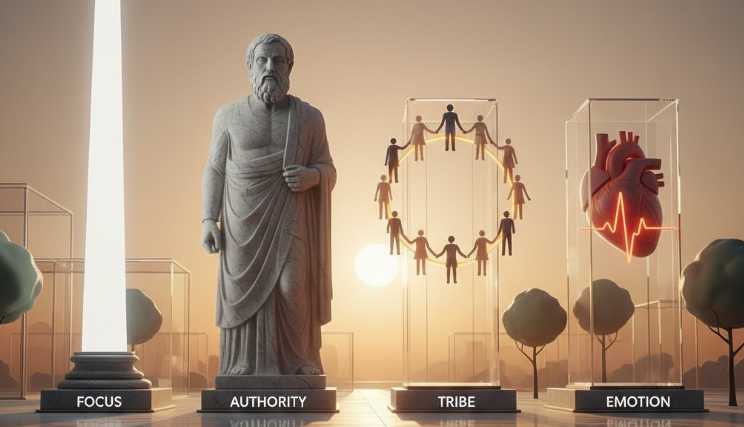
This is why, when I learned about Hughes’ FATE model, it resonated so strongly with me. It doesn’t fight human wiring; instead, it works with it. The beauty of FATE is that it breaks influence into four parts that anyone can use:
Focus
Authority
Tribe
Emotion
Let’s look at how FATE shows up in everyday business life.
Focus: Breaking the Internal Script
Every customer you meet has an internal script playing in the background. They’re distracted, stressed, and thinking about a dozen other things. If you don’t interrupt that script, nothing else works.
Focus isn’t about being louder. It’s about waking the customer up just enough for them to be fully present. Our hunter ancestors were wired this way. A sudden crack in the forest could mean danger or dinner. Emotional intensity always came first.
We still operate the same way. Today, the rustle in the bushes is financial stress, time pressure, or our phone buzzing in our pocket. Our brains conserve energy by running on autopilot.
A great plumber knows how to create the modern version of a rustle in the bushes. He steps into the home, pulls a small torch from his bag, flicks it once to ignite it, then shuts it off. Nothing dramatic. He creates a sound just novel enough that the homeowner snaps out of whatever they were thinking about. And that’s when he asks, “Tell me when you first noticed the issue?” That single moment of novelty earns him more attention than a three-minute technical explanation ever would.
Focus is about presence and pacing. When you cut through the noise, people step toward you instead of away.
Authority: The Quiet Signal Customers Trust
Authority isn’t about dominance or bravado. Hughes teaches us that authority is transmitted through five small behaviors:
Certainty
Composure
Presence
Command of space
And clear language
When you see someone who carries themselves that way, you feel it.
One of the clearest examples of quiet authority I’ve ever seen came from a home inspector I hired to look at a rental property I was considering buying. After he finished his inspection, he met me at the kitchen counter. He opened the report the way a doctor opens a medical chart, flipping to a single photo. Then he placed his finger on an image and said, “This is the one area I think you should really pay some attention to.”
No rush, no posturing, and his voice stayed steady. His gestures were deliberate. He didn’t overwhelm me with the dozens of minor notes he could have talked about. He focused on the one thing that mattered most and explained it to me in plain English. In that moment, his uniform, tools, and calm delivery made it all come together. I didn’t have to wonder whether I could trust him. I already did. That’s authority: composure plus clarity at the exact moment I needed both.
In the 1960s, psychologist Stanley Milgram ran a famous study, known in psychology as the Milgram experiment, in which a lab-coat-wearing experimenter instructed ordinary people to deliver what they believed were ever-increasing levels of painful electric shocks to another person they could hear screaming in pain in the other room. Most participants in the study kept administering increasing levels of painful electric shocks far longer than anyone expected. Not because the experimenter threatened them. Not because the participants were exceptionally cruel. They followed the experimenter’s instructions because he projected calm, steady authority at a moment when they felt unsure. Humans lean toward people who exhibit authority. It’s not a weakness but part of our internal wiring.
For small businesses, the lesson is simple—clarity, calmness, and clear language project authority. People trust you when they feel safe around you.
Tribe: Being Part of Their “We Group”
This is the pillar most people underestimate. Chase calls it “Tribe,” but I call it “we groups.” It’s the moment your client stops seeing you as a stranger and starts seeing you as someone from their world or tribe.
Humans are herd animals. We take cues from each other. If you’ve ever watched a field of deer grazing, you have seen how this works. Not every deer can watch in every direction. They survive by paying attention to each other. If one deer hears or spots something unusual, it breaks its focus and lifts its head; the rest follow instantly and instinctively. When one bolts, the entire herd bolts. The herd’s safety depends on shared vigilance.
That’s tribal intelligence. Today, we know it as social proof. That’s belonging.
Last summer, I hired Matt, a former client of mine, to prune some dead scrub oak limbs on my property. I thought it was just another summer maintenance job. However, not long after my neighbors heard his chainsaw come to life and saw him clear out our dead branches and pile them up in my front yard so I could take them to the recycling station, they began texting me asking me for his contact information. One after another, they wanted to hire Matt to do the same job in their yards. Nobody needed a sales pitch. They just watched someone in their own “we group,” me in this case, trust him first, and that was enough for them to know Matt was their guy.
We all take cues from the people around us, just like a herd watching the first deer lift its head. But Tribe goes deeper than that. It shows up in the tiny personal moments.
A massage therapist notices a client’s Broncos mug and says, “Great season, isn’t it?” A house painter kneels down to greet the family’s German Shepherd before greeting the homeowner. A landscaper notices a client’s veteran license plate and mentions their own service background. In those moments, you stop being “the plumber” or “the contractor.” You become “one of them.”
This is why Cialdini’s Liking principle works so well. We simply like people who are similar to us. We trust our own.
You can even take this further with tools like the Data Axle Lifestyle Database, something I’ve written about before. It helps you understand the hobbies, interests, and affinities of the customers you are targeting. Not to manipulate anyone, but to know which “we groups” exist so you can connect with the prospect authentically.
And here’s the ethical line: authenticity matters. In Daniel Pink’s To Sell Is Human, he tells a story about a salesman who pretended to share every customer’s obscure experience, claiming he’d recently visited Yugoslavia even though he couldn’t find it on a map. It worked for him in a fast-churn sales environment, but for a small business owner who lives on referrals and repeat clients, that approach is poison.
Tribe is powerful because it taps into something older than language: belonging equals safety.
Emotion: The Oldest Operating System
Emotion, the fourth pillar of the FATE model, is what carries the decision across the line. Recall that the logical brain always justifies what the emotional brain has already chosen.
This wiring goes back to our hunter-gatherer ancestors. Hunters made emotional decisions instantly. Fight, flee, chase, hide. Farmers learned a different emotional pattern—worry about the future, fear of loss, and the need for predictability. We carry both systems today.
This is also where Donald Miller’s StoryBrand framework fits perfectly. Your customer is the hero facing a problem. You’re the guide. The emotional journey, frustration, hope, fear, and relief are what actually move the story forward. Miller argues that they’re not buying your product or service; they’re buying an emotional transformation.
A good cleaning company doesn’t just vacuum carpets. It gives the homeowner emotional peace.
A massage therapist isn’t just working on muscles. They’re giving their client their evening back.
A plumber isn’t just fixing pipes. He’s removing embarrassment and preventing future stress.
And underneath it all are two emotional script systems driving behavior: Ancestral scripts, the ones we’re born with. Threat detection. Belonging. Reciprocity. Avoiding ambiguity. Preferring stories. And Life scripts, the ones we develop through personal experience. Bad contractors. Pushy salespeople. Money anxiety. Childhood patterns. Professional trauma.
Emotion is where these two systems collide. And when you respect both, decisions start to feel natural instead of forced.
Bringing FATE Model Together
The FATE model, built by Chase Hughes, is one of the most practical ways to understand human influence without getting lost in complexity. It explains why certain interactions flow effortlessly, and others get stuck in hesitation.
Focus cuts through the noise.
Authority settles the mind.
Tribe creates belonging.
Emotion moves the decision.
When all four align, influence isn’t manipulative. It’s human. It’s clear. It’s the kind of guidance people appreciate because it makes their lives easier, not harder. And in a noisy, distracted world, that might be the most valuable skill a business owner can develop.
Where can you apply the FATE model in your business today?